Rewards



A chunky blanket is the project that gets people into yarn: thick strands, big needles or a big hook, a throw in a weekend instead of a season. The catch is that "chunky blanket yarn" covers four very different materials, and the photos online don't tell you which one sheds, which one pills, which one weighs eleven pounds and which one you can't wash.
This guide sorts that out, then does the yardage math so you buy the right amount once.
What counts as chunky
In the Craft Yarn Council scale, "chunky" is category 5 (bulky), "super chunky" is category 6 (super bulky) and the giant stuff is category 7 (jumbo). Bulky knits at 12 to 15 stitches per 4 inches on US 9 to 11 needles; super bulky at 7 to 11 stitches on US 11 to 17; jumbo at 6 or fewer on US 17 and up, or your arms. Most "chunky blanket" projects use super bulky or jumbo. Full weight chart here.
The four kinds of chunky blanket yarn
1. Chenille (polyester "blanket yarn")
The velvety tube yarn in most big-box chunky blanket kits. Soft, cheap, machine washable, and available in every color. The trade-offs: it "worms" (stitches work loose and poke out as little loops) if your tension is loose, it sheds fuzz for the first few washes, and it's polyester, so it doesn't breathe and can pill. Good for a kids' throw or a couch blanket that gets washed a lot. Knit or crochet it tightly.
2. Merino roving (the giant "arm knit" look)
Unspun or barely spun wool, as thick as your wrist. Makes the dramatic blankets in the photos. Beautiful and warm, but unspun wool pills and felts with use, can't be machine washed, and a throw can cost several hundred dollars in yarn. Best as a decorative piece on the end of a bed, not a blanket you wrap up in nightly. Core-spun or tube-felted versions last much longer than loose roving.
3. Spun wool and wool blends
Super bulky wool that's actually spun, like a thick version of normal yarn. The best all-round chunky blanket yarn: it holds its shape, doesn't worm, wears for years, and hand washes. A wool-acrylic blend brings the price down and adds machine washability. Our superwash chunky merino is this kind.
4. Chunky silk and sari ribbon
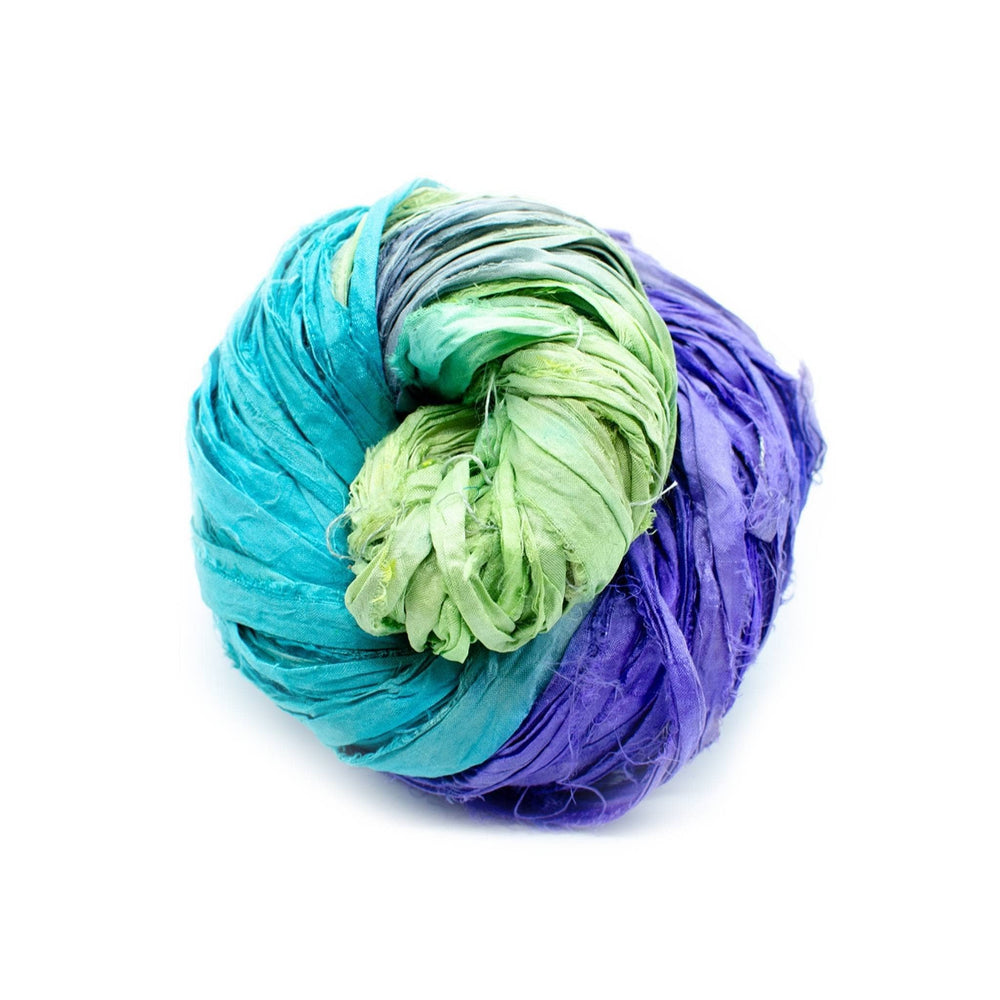
Hand-spun recycled silk in bulky and super bulky weights, and sari silk ribbon, are the chunky yarns for a blanket with drape and shine rather than loft. They're heavier per yard than wool, so they suit a lapghan or a throw at the foot of a bed more than a full-size blanket, and they make a textured, one-of-a-kind piece in a way acrylic can't. Our chunky recycled silk and sari ribbon are both spun by hand by artisans in India and Nepal.
How much chunky yarn for a blanket
| Blanket | Size (inches) | Super bulky (cat. 6) | Jumbo (cat. 7) |
|---|---|---|---|
| Baby | 30 x 36 | 300-400 yds | 150-200 yds |
| Lapghan | 36 x 48 | 450-600 yds | 220-300 yds |
| Throw | 50 x 60 | 800-1,100 yds | 400-550 yds |
| Twin | 66 x 90 | 1,600-2,100 yds | 800-1,000 yds |
| Queen | 90 x 100 | 2,800-3,600 yds | 1,400-1,800 yds |
Crochet uses about 25 percent more than knitting for the same size; use the top of each range. Chenille skeins are typically about 250 yards, so a throw is four to five skeins. Buy one extra and keep the receipt.
Needles, hooks and arms
- Super bulky: US 13 to 17 needles (9 to 12 mm), or an N/P-15 to Q hook (10 to 16 mm).
- Jumbo: US 19 to 50 needles (15 to 25 mm), a 20 mm+ hook, or arm knitting.
- Arm knitting uses your forearms as needles and takes about an hour for a throw in jumbo roving. The stitches are enormous and open, so it's a decorative blanket, not a warm one. How to arm knit.
Stitches that work in chunky yarn
Simple ones. Texture is lost in thick yarn and cables become ropes. Garter stitch, seed stitch and 2x2 rib in knitting; half double crochet, moss stitch and the open stitches that save yarn in crochet. For a full first-blanket walkthrough, how to knit a blanket and how to crochet a blanket both have chunky-yarn numbers.
Living with a chunky blanket
- Weight. A super bulky wool throw weighs 3 to 4 pounds; a jumbo roving throw can be 8 or more. Pleasant on a bed, heavy on a lap.
- Washing. Chenille and acrylic: machine, gentle, lay flat. Spun wool: hand wash or wool cycle, lay flat. Roving: spot clean only. Silk: hand wash cool, lay flat. Full washing guide.
- Pets. Chenille catches claws; roving felts under a sleeping cat. Spun wool and silk hold up best.
- Storage. Fold, don't hang; a chunky blanket on a hook stretches under its own weight.
Which one should you buy?
For a washable couch throw on a budget: chenille, knit tightly. For a blanket you'll keep for a decade: spun super bulky wool or a wool blend. For the look in the photos: core-spun merino, as a decorative piece. For something no one else has: chunky recycled silk or sari ribbon, in a lapghan.
If you'd like to try chunky yarns without committing to a blanket's worth, Yarn of the Month sends three hand-dyed skeins a month in rotating weights, chunky included some months, with a pattern written for them. $29 a month plus shipping.
Chunky blanket yarn FAQ
What is the best yarn for a chunky blanket?
Spun super bulky wool or a wool blend for durability and warmth; chenille for a cheap, washable throw; core-spun merino for the oversized decorative look. Avoid loose roving for a blanket that will be used daily.
How many skeins of chunky yarn for a blanket?
A 50 x 60 throw takes 800 to 1,100 yards of super bulky, which is four to five 250-yard skeins, or 400 to 550 yards of jumbo. Buy one extra.
Does chunky chenille yarn shed?
Yes, lightly, for the first few washes, and it can "worm" if worked loosely. Knit or crochet it tightly and wash it on gentle in a mesh bag.