Rewards



Instinct says single crochet uses the least yarn because the stitches are small and tight. Instinct is wrong. Tight stitches pack the most yarn into every square inch; it's the open, tall and spaced stitches that cover a scarf or shawl with the fewest yards. If you've got one small skein, or a bag of scraps, or you want a light fabric for summer, these are the stitches to reach for.
Below: the nine most yarn-efficient crochet stitches ranked by roughly how much they save compared with single crochet, then the thin stitches for lightweight fabric, then how to stretch any skein further.

How yarn use actually works
Two things decide how much yarn a stitch eats per square inch: stitch height (taller stitches cover more area per yarn-over) and spacing (chains between stitches cover area with almost nothing). Single crochet is short and has no spacing, so it's the hungriest common stitch. Double crochet uses roughly 15 to 20 percent less yarn for the same area. Add chain spaces and the savings jump to 30 to 50 percent.
The numbers below are approximate; your tension and yarn will shift them. The ranking holds.
The 9 crochet stitches that use the least yarn
1. Solomon's knot (lover's knot). The champion. Long drawn-up loops locked with a single crochet, making a net that's mostly air. Uses around 50 to 60 percent less yarn than single crochet for the same area. Beautiful in shawls, wraps and summer scarves; not for anything that needs structure.
2. Trellis stitch (chain-loop mesh). Arches of chain-5 anchored with single crochets. Fast, light, forgiving. Around 45 to 50 percent savings. The stitch in the image above.
3. Filet mesh (double crochet, chain 1 or 2). An open grid of double crochets and chain spaces. Around 40 percent savings, with a crisp geometric look that suits table runners, market bags and curtains.
4. V-stitch. Two double crochets with a chain between, worked into the same space. Around 30 to 35 percent savings, with more body than mesh. The go-to for a light blanket from limited yarn.
5. Treble crochet, open. Tall stitches with a chain between. Around 30 percent savings and very fast rows. Lovely in silk, where the drape shows.
6. Granny stitch (clusters with chain spaces). Three double crochets, chain, repeat. Around 25 to 30 percent savings, and the scrap-friendliest stitch in crochet since every row can be a new color.
7. Shell stitch, open. Fans of doubles separated by chains or single crochets. Around 20 to 25 percent savings with a dressier look.
8. Double crochet. Plain rows of double crochet, no spaces: around 15 to 20 percent less than single crochet. Dense enough for a hat, still cheaper than single.
9. Half double crochet. Around 10 percent savings over single crochet, and a fabric almost as sturdy. Choose it over single crochet for anything that doesn't need to be stiff.
At the bottom of the list, using the most yarn: single crochet, then any post stitch, bobble, puff or popcorn. Texture is expensive.

Thin crochet stitches for lightweight fabric
If the goal is a fabric that's thin and drapey rather than simply cheap, the answer is the same stitches plus two adjustments:
- Go up two hook sizes from the yarn label. A worsted yarn on a K or L hook makes a fabric that's thin, soft and fast.
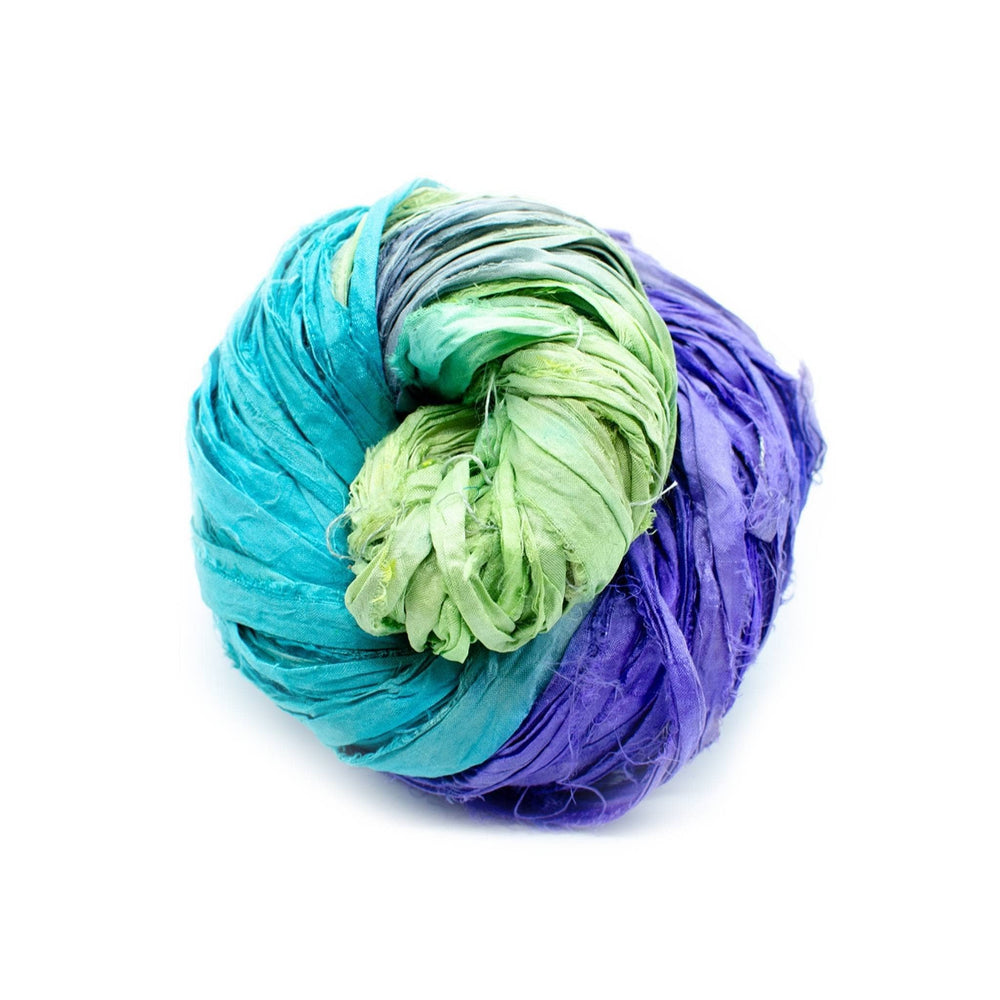
- Choose a yarn with drape. Silk, bamboo, linen and cotton blends hang; acrylic and wool spring back. Our recycled silk in an open stitch makes a wrap you can pull through a ring.
- Thin stitches to try: extended single crochet, linked double crochet, and the V-stitch and filet mesh above. The larksfoot stitch is a good middle ground: open spikes, light fabric, still some structure.
How to stretch any skein further
- Weigh it. A kitchen scale and the label's yards-per-gram tell you exactly how much is left. Weigh at the halfway point of a symmetrical project.
- Loosen up. Even in a dense stitch, a looser gauge saves 10 to 15 percent.
- Make it narrower, not shorter. A 5-inch scarf reads as a scarf; a 40-inch scarf reads as a mistake.
- Add a second yarn at the edges. A contrasting border or tassels in scrap yarn adds inches without touching the main skein. More scrap-yarn ideas here.
- Pick the project to fit the skein. Our one-skein crochet list is sorted by yardage for exactly this.
Which stitch should you use?
Scarf or wrap from one skein: trellis, Solomon's knot or V-stitch. Blanket from limited yarn: V-stitch or granny stitch. Market bag: filet mesh. Something warm: half double crochet, the cheapest of the solid stitches. Scraps: granny stitch, always.
FAQ
Does single crochet use more yarn than double crochet?
Yes. For the same area, single crochet uses roughly 15 to 20 percent more yarn than double crochet, because it's shorter and packs more stitches into each inch.
What is the fastest crochet stitch that uses the least yarn?
Trellis stitch and Solomon's knot are both fast and extremely yarn-efficient. Treble crochet with chain spaces is nearly as quick with a more structured look.
Does crochet use more yarn than knitting?
Usually, yes: roughly 20 to 30 percent more for the same solid fabric, because crochet stitches are taller and thicker. Open crochet stitches close most of that gap.
Written by Jordan Lemley; updated October 2026. If you'd like a monthly skein with a pattern already sized for it, Yarn of the Month sends three hand-dyed skeins and a crochet and knit pattern every month for $29 plus shipping.