Rewards



Tunisian simple stitch (Tss) is the first stitch everyone learns in Tunisian crochet. The fabric looks woven, with neat vertical bars across the front and a dense, warm hand between knitting and crochet.
It's beginner-friendly, but it feels different from regular crochet because you work in two passes. On the forward pass you pick up a loop from every stitch and keep them all on the hook. On the return pass you work them off two at a time. The one thing that makes it work is the long hook: you need room for every loop in the row.
Watch: Tunisian Simple Stitch Video Tutorial
Watch how the hook slides behind each vertical bar on the forward pass, and how the return pass starts with one chain before the two-at-a-time repeat.
What You Need
A Tunisian (afghan) hook: a long crochet hook with a stopper or cable on the end so the loops don't fall off. Go up one or two sizes from what you'd use for regular crochet with the same yarn, because Tunisian fabric is dense. A smooth, light-colored worsted or DK weight yarn shows the vertical bars best while you're learning.
Abbreviations (US terms): ch = chain, Tss = Tunisian simple stitch, YO = yarn over, FwP = forward pass, RetP = return pass, st(s) = stitch(es).
Tunisian Simple Stitch Written Steps
From the original post: In this simple Tunisian Crochet how-to video, Phanessa Fong walks you through how to cast on and make Tunisian Simple Stitches using Darn Good Yarn's Banana Fiber Yarn. Get the Tunisian Crochet Scarf Pattern by Phanessa Here.
Foundation row, forward pass: Chain the number of stitches you want. Skip the first chain. Insert the hook into the back bump of the next chain, YO, pull up a loop, and leave it on the hook. Repeat in every chain to the end. Count your loops; this is your stitch count.
Foundation row, return pass: YO and pull through one loop. Then YO and pull through two loops. Repeat the YO-through-two until one loop remains on the hook.
Row 2 and every row after, forward pass: Skip the first vertical bar (the loop on your hook is the first stitch). Insert the hook from right to left behind the next vertical bar, YO, pull up a loop. Repeat across. At the last stitch, insert the hook under both strands of the edge stitch, YO, pull up a loop.
Return pass: Same as the foundation return pass: YO, pull through one; then YO, pull through two, repeated until one loop remains.
Step-by-Step: How the Technique Works
- Load the hook. On the forward pass you don't finish any stitches. You pick up one loop per stitch, right to left, and the hook fills like a knitting needle. Don't turn the work.
- Find the bar. After the foundation row, each stitch has a vertical bar on the front. The hook goes behind that bar, from right to left.
- Close the row. The return pass works the loops off from left to right. The first "pull through one" makes an edge chain; every "pull through two" closes one stitch. Each row lands directly on the one below, which is why the fabric looks like a grid.
- Keep the edges straight. The loop on your hook at the start of a forward pass counts as the first stitch, and the last stitch is worked under two strands. That's where the count drifts.
Tips and Common Mistakes
- It will curl. Tunisian simple stitch curls toward you at the bottom. A hook two sizes larger, a row or two of Tunisian purl at the start, and blocking all help, and a border finishes the job.
- Count after every forward pass. Losing a stitch at the left edge is the most common error. Work the last stitch under both strands of the edge, every row.
- Don't pull the return pass tight. Pulling hard on the return makes the fabric board-stiff. Let the loops stay relaxed on the hook.
- Yarn use is higher than single crochet for the same area. Buy an extra skein for a blanket.
When You'll Use This
Tunisian simple stitch is the foundation for every other Tunisian stitch, and on its own it's ideal for scarves, cowls, washcloths, and dense, warm blankets. Once you're comfortable, the Tunisian crochet stitches guide covers the knit, purl, and full stitches that use the same forward-and-return rhythm. Worsted and DK weights are the easiest to start with; bulky makes a fast, heavy throw.
Related Stitches
- Crochet Tunisian Stitch — a swatch pattern to practice the simple stitch on
- Crochet Starting Chain — the foundation chain every Tunisian piece begins with
- Single Crochet Stitch — the regular-crochet stitch that feels closest to Tunisian fabric
- Browse every crochet stitch tutorial
Yarn for This Stitch
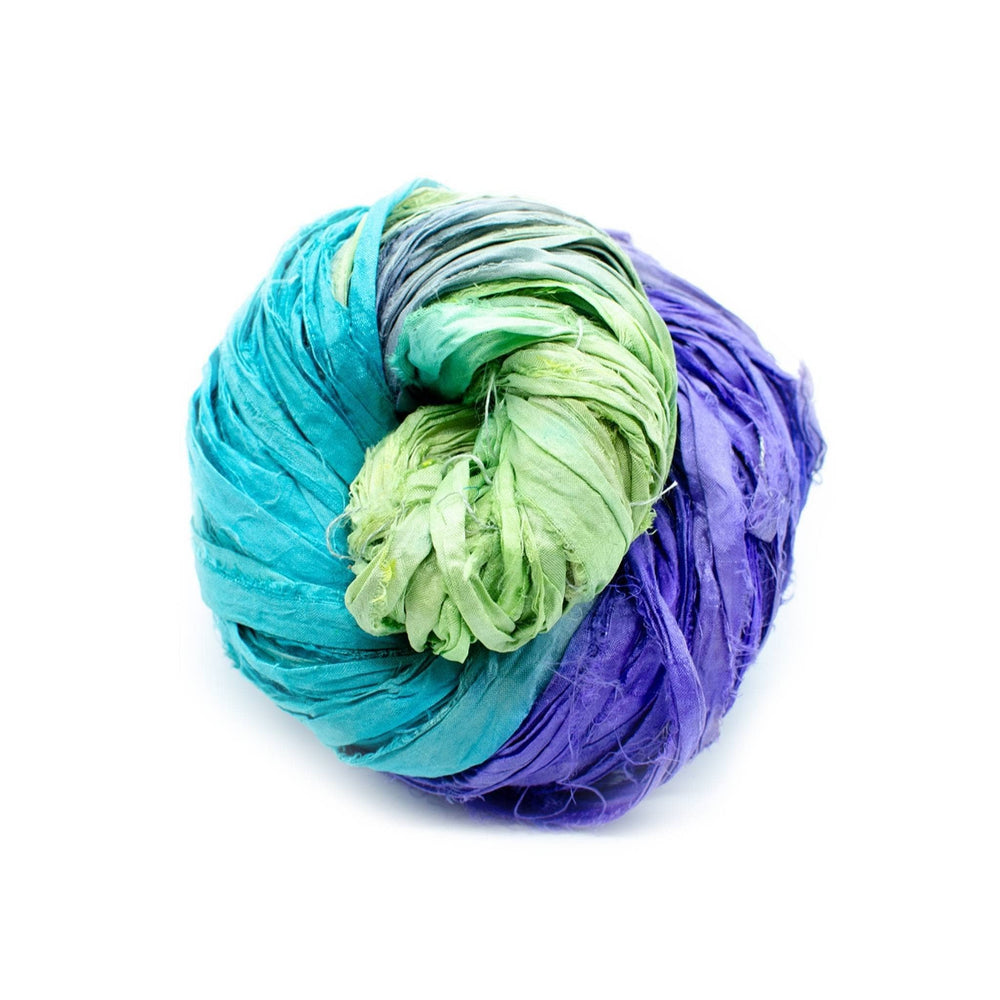
A smooth, even yarn makes the vertical bars easy to find. Darn Good Twist Sport Weight Silk Yarn works well with a larger Tunisian hook, and DGY's worsted weight yarn is quickest to learn on. Both are recycled silk, hand-dyed by artisans in India.
If you'd like a new skein to practice on every month, Yarn of the Month sends three hand-dyed skeins with a knit and crochet pattern written for them, $29 a month plus shipping.
Tunisian Simple Stitch FAQ
Do I need a special hook for Tunisian crochet?
For anything wider than a few stitches, yes. A Tunisian hook is long with a stopper on the end so the whole row of loops stays on.
Why does my Tunisian simple stitch curl?
The forward pass puts all the tension on the front of the fabric. A larger hook, a looser return pass, and blocking all reduce it, and a border finishes the job.
Is Tunisian simple stitch the same as the afghan stitch?
Yes. Afghan stitch is the older name for the same stitch, which is also why the long hook is called an afghan hook.