Rewards



Tunisian crochet (also called Afghan crochet) is the craft between knitting and crochet. You use one long hook with a stopper on the end, you keep a whole row of loops on it at once like a knitter, and you work them off with crochet motions. The fabric is thick, square and woven-looking, and the stitches have names you won't find anywhere else.
If you crochet already, you can learn it in an afternoon. Here's how it works, the six stitches that cover most patterns, and how to deal with the curl.
How Tunisian crochet works: the two passes
Every Tunisian row is two passes.
Forward pass: working right to left, you pull up a loop in each stitch across the row and leave them all on the hook. At the end you have as many loops as stitches.
Return pass: without turning the work, yarn over and pull through one loop, then *yarn over, pull through two loops* until one loop remains. That closes the row.
You never turn the work, so the right side always faces you. The different Tunisian stitches are all variations on where you insert the hook on the forward pass; the return pass is almost always the same.
The hook and yarn you need
- A Tunisian (Afghan) hook: a long straight hook with a knob or stopper on the end, or a regular hook with a cable attached for wider work. 10 to 14 inches holds a scarf; a cabled hook holds a blanket. Use a hook one or two sizes larger than you would for regular crochet with the same yarn: Tunisian fabric is dense, and a bigger hook keeps it soft.
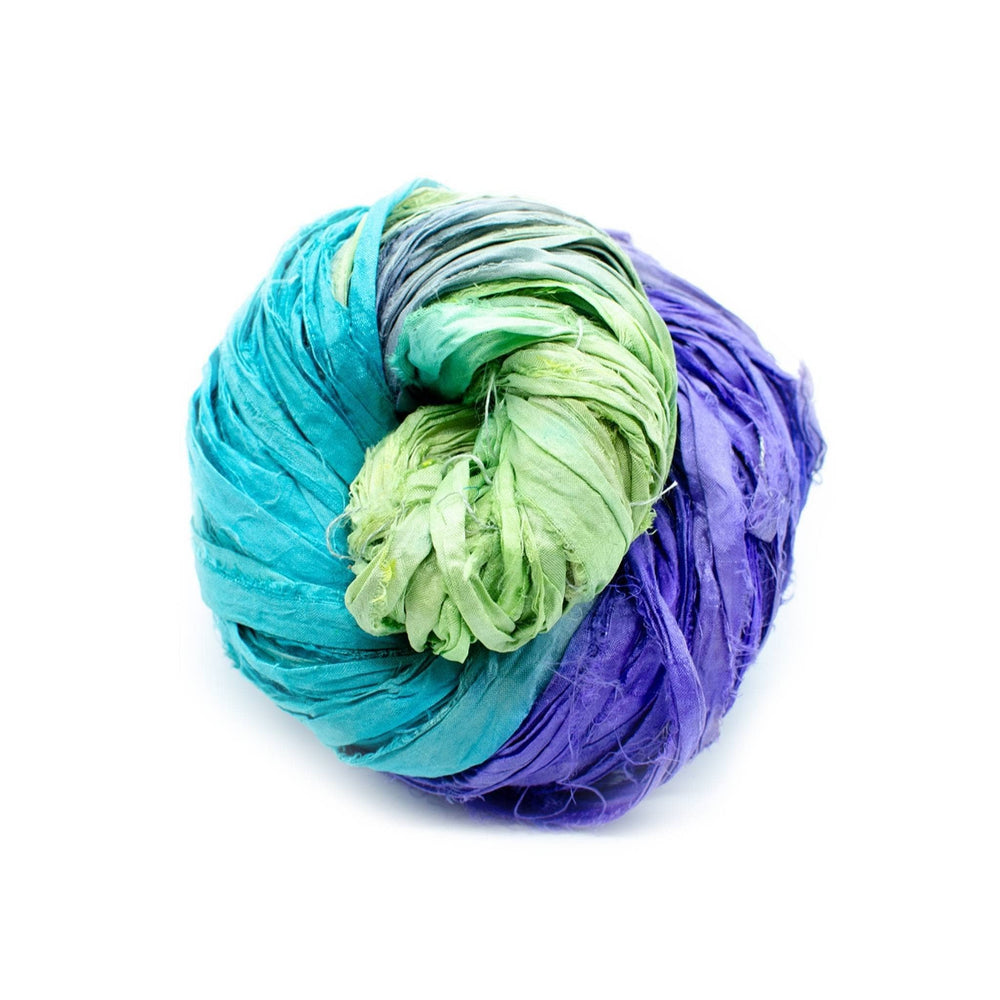
- Smooth, light yarn for learning. The stitches are small and close; dark fuzzy yarn hides them. Worsted on an L-11 (8 mm) Tunisian hook is a good start. Silk and silk blends show the woven texture beautifully.
The foundation row
Chain the number of stitches you want. Forward: insert the hook in the second chain from the hook, yarn over, pull up a loop; repeat in every chain across. Return: yarn over, pull through one; then *yarn over, pull through two* to the end. Every stitch below builds on this row.
The six Tunisian crochet stitches to learn first
1. Tunisian simple stitch (Tss). The foundation stitch. On the forward pass, insert the hook from right to left behind the vertical bar of each stitch, pull up a loop. Return pass as usual. Makes a fabric of neat vertical bars with a slight diagonal lean. Used for almost everything; the one to practice until it's automatic.
2. Tunisian knit stitch (Tks). Insert the hook through the middle of the stitch, from front to back between the front and back vertical bars, and pull up a loop. Looks exactly like stockinette knitting. Thick, warm and the one that curls most.
3. Tunisian purl stitch (Tps). Bring the yarn to the front, insert behind the vertical bar as for Tss, then yarn over from the front and pull up the loop. Makes a bumpy row like knit purls. Alternate rows of Tks and Tps for ribbing; alternate stitches for a seed look.
4. Tunisian full stitch (Tfs). Insert the hook between two vertical bars (into the space, not the stitch) and pull up a loop; shift one space over on alternate rows so the stitches stagger. Dense, woven and flat. The stitch for bags and baskets.
5. Tunisian reverse stitch (Trs). Insert the hook behind the vertical bar from the back of the work, pull up a loop. The texture of Tps on the other side. Flat and sturdy; good with Tss in stripes.
6. Tunisian honeycomb. Alternate Tss and Tps across the row, then swap them on the next row. A thick, reversible, cushioned fabric that barely curls. The one to use for a first blanket.
How to stop Tunisian crochet from curling
Tunisian fabric, especially Tss and Tks, curls toward you at the bottom. It's the single thing everyone asks about. Five fixes, in order of effectiveness:
- Use a bigger hook. Two sizes up from regular crochet. Tight fabric curls; loose fabric lies down.
- Start with a few rows of purl or honeycomb. Purl stitches counteract the curl, so a Tps border on the bottom and top flattens the piece.
- Add a border. A round of single crochet or two rows of Tps around the edge.
- Block it. Wet or steam block, pin flat, let dry. This fixes most of what the hook size didn't.
- Choose flat stitches. Honeycomb, full stitch and reverse stitch curl far less than Tss and Tks.
Binding off and finishing
After your last return pass, work a row of slip stitches: insert the hook as for Tss into each vertical bar, yarn over, pull through the bar and the loop on the hook. This closes the top edge so it matches the bottom. Weave in the ends, then block.
What to make with Tunisian crochet
Tunisian uses about 20 to 30 percent more yarn than regular crochet for the same area because the fabric is dense, so start small. A washcloth in Tss or honeycomb is the right first project. Then a scarf in Tks with a Tps border, a bag in full stitch, a cushion cover in honeycomb, and a baby blanket once you have a cabled hook. The blanket size chart works for Tunisian if you add 25 percent to the yardage.
Tunisian also takes color beautifully: the vertical bars of Tss make a grid you can cross-stitch over, which is how most Tunisian colorwork is done.
If you'd like yarn to practice on arriving monthly, Yarn of the Month sends three hand-dyed skeins with a crochet and knit pattern each month, $29 plus shipping; the smooth silk is a good match for the stitch definition Tunisian needs.
Tunisian crochet FAQ
Is Tunisian crochet hard?
No, if you already crochet. The forward and return pass take an hour to learn; Tunisian simple stitch is easier than double crochet. The challenges are the curl and keeping even tension on a hook full of loops.
Can I do Tunisian crochet with a regular hook?
For a narrow piece like a bookmark or a headband, yes, if the hook has a straight shaft with no thumb rest. Anything wider needs a Tunisian hook or a cabled one, because all the loops have to fit.
What is the easiest Tunisian crochet stitch?
Tunisian simple stitch. It's the one all the others are built on, and a washcloth in Tss is the standard first project.