Rewards



The knit herringbone stitch makes a fabric that looks woven, not knit. Each stitch leans into its neighbor, and the lean flips direction every row, so the surface builds up in the chevron pattern you'd see on a tweed jacket.
It's a dense, firm fabric with almost no stretch. That makes it a poor choice for a fitted sweater and a very good choice for bags, pillow fronts, cowls, and scarves that need to hold their shape.
The stitch is a two-row repeat and uses only one real move: knit (or purl) two stitches together but drop only the first one off the needle. It's listed as beginner, and the hardest part is managing tension on a stitch that wants to be tight.
Watch: Knit Herringbone Stitch Video Tutorial
Watch how Mike works the two stitches together and then slides only the first one off the left needle, leaving the second to be worked again.
What You Need
Any yarn weight works, but the pattern note is important: go up two needle sizes from what the yarn usually calls for, then drop back to your regular size for the bind off. The stitch pulls in hard, and bigger needles keep the fabric from turning into cardboard. A smooth, light-colored yarn shows the diagonal lean clearly while you learn; for a worsted yarn, that means something like a US 10 (6mm) needle for the body.
Abbreviations: k2tog = knit two together, p2tog = purl two together, tbl = through the back loop, RS = right side, WS = wrong side, sl = slip.
Stitch multiple: any number of stitches. The swatch casts on 40.
Knit Herringbone Stitch Written Pattern
This is a very dense stitch. We recommend going up two needle sizes from what you usually use for this yarn weight and then dropping down to your regular size for the bind off.
Cast on 40 stitches.
Row 1 (RS): k2tog through the back loop, dropping only the first stitch, continue in this manner across the row to the last stitch, slip 1.
Row 2 (WS): p2tog, dropping only the first stitch, continue in this manner across the row to the last stitch, slip 1.
Repeat rows 1 and 2 for pattern to desired length.
Step-by-Step: How the Stitch Works
- Row 1, first stitch. Put the right needle through the back loops of the first two stitches, as for k2tog tbl, and knit them together. Now slide only the first stitch off the left needle. The second stitch stays put.
- Repeat with the stitch that stayed. That leftover stitch becomes the first of the next pair. Knit it together with the one after it, drop one, keep one. Every stitch gets worked twice, which is what makes the fabric lean and lock.
- Finish the row. When one stitch is left, slip it to the right needle without working it. Your count stays at 40.
- Row 2 mirrors it in purl. Turn, p2tog the first two stitches through the front, drop only the first, and repeat across. Slip the last stitch.
- Keep going. Row 1 leans the stitches one way, Row 2 leans them the other. Stacked up, the rows read as the herringbone chevron on the right side.
Tips and Common Mistakes
- If the second row is nearly impossible to get the needle into, your needles are too small or you're pulling the yarn too tight after each stitch. Loosen up; the fabric will still be firm.
- Count at the end of each row. If you dropped both stitches instead of one, you'll be short, and the error shows as a hole.
- Don't forget the slipped stitch at the end of each row. Working it instead leaves an uneven, stretched edge.
- The fabric does not curl, but it does pull in. Cast on about 25 percent more stitches than a stockinette swatch would need for the same width.
- Bind off on the smaller needle and keep it relaxed, or the top edge will flare compared with the dense body.
What to Make With the Knit Herringbone Stitch
This is a structure stitch. In worsted or aran yarn it makes a tote or clutch that stands up on its own and a pillow cover that doesn't sag. In bulky yarn it's a quick cowl or a winter scarf with no curl and no droop; the sizing in our how to knit a scarf guide applies, just allow extra width for the pull-in. In DK, try a table runner or placemats, where the woven look fits.
Related Stitches
- Knit Stockinette Stitch — the basic fabric herringbone is built from
- Knit Basketweave Stitch — another woven-look texture, with more stretch
- Knit Diagonal Basket Weave — a next step if you like diagonal fabrics
- Browse every knit stitch tutorial
Yarn for This Stitch
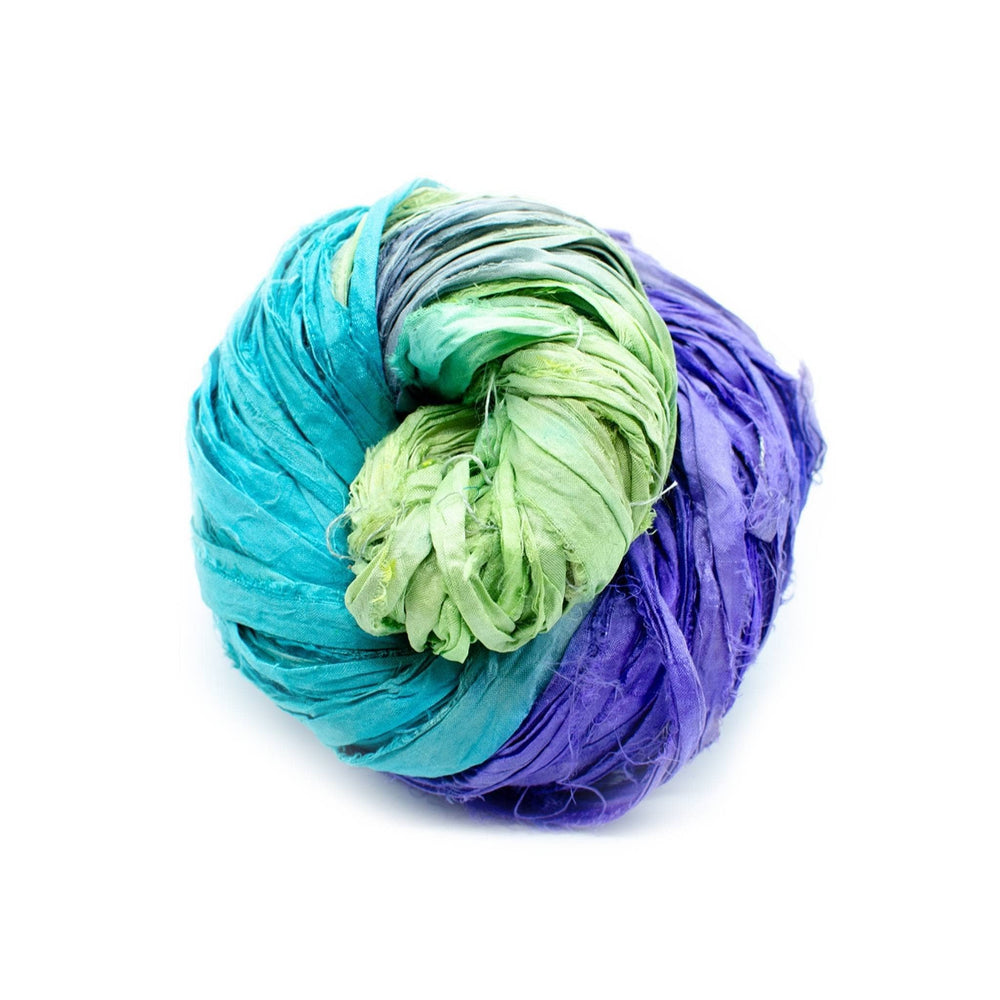
Herringbone needs a yarn that can take some friction, since every stitch is worked twice. A smooth worsted weight yarn is the easiest place to start, and bulky weight makes a fast cowl or bag. Our recycled silk is hand-dyed by artisans in India and comes in weights from lace through super bulky if you want sheen on the chevrons.
If you'd like a new skein to practice on every month, Yarn of the Month sends three hand-dyed skeins with a knit and crochet pattern written for them, $29 a month plus shipping.
Knit Herringbone Stitch FAQ
Is the herringbone stitch hard to knit?
The move is easy; the tension is the challenge. Use bigger needles than usual and keep your working yarn relaxed and it goes smoothly.
Does herringbone stitch curl?
No. The alternating lean of the rows balances the fabric, so edges lie flat without a border.
Is the knit herringbone stitch reversible?
Not quite. The wrong side has a texture of its own, like small purl bumps on a diagonal, but the clear chevron shows on the right side only.