Rewards



The basketweave stitch is a knit-and-purl pattern that looks like strips of fabric woven over and under each other. Blocks of stockinette sit next to blocks of reverse stockinette, and every five rows the blocks swap places. The result is thick, squishy, and the same on both sides.
It's rated intermediate only because you have to keep track of where you are in a ten-row repeat. The stitches themselves are just knit and purl. There are no yarn overs, no decreases, and no cable needle.
The one thing that makes it work is reading your knitting. Once you can see a knit block and a purl block on the needle, you stop counting and start matching: knits over knits, purls over purls, until it's time to switch.
Watch: Basketweave Stitch Video Tutorial
Watch how Mike moves the yarn to the front before a purl block and to the back before a knit block, and how the switch rows (6 and 7) shift the blocks over.
What You Need
Yarn: a smooth, light-colored worsted weight yarn shows the blocks best while you learn. The texture depends on the contrast between knit and purl surfaces, and fuzzy yarn blurs that line.
Needles: US 7 or 8 (4.5–5mm) for worsted. Basketweave is dense, so don't go smaller than the yarn label suggests.
Abbreviations: K – knit; P – purl; CO – cast on. "k5, p5" means knit 5 stitches, then purl 5.
Stitch multiple: multiple of 10, plus 5. The swatch casts on 35 for three and a half blocks, so the pattern is balanced at both edges.
Basketweave Stitch Written Pattern
Basketweave Stitch
CO 35 stitches
Rows 1, 3, and 5: *k5, p5, repeat from * to last 5 stitches, k5
Rows 2 and 4: p5, *k5, p5, repeat from *
Rows 6, 8, and 10: k5, *p5, k5, repeat from *
Rows 7 and 9: p5, *k5, p5, repeat from *
Repeat Rows 1–10 until the swatch measures 6 inches, then bind off.
Step-by-Step: How the Stitch Works
- Rows 1–5 build the first band. On the right side you knit 5, purl 5 across, ending with a knit block. On the wrong side you purl the stitches that were knit and knit the ones that were purled. After five rows, each block is roughly square.
- Row 6 is the switch. It's a wrong-side row, but instead of matching the row below, you knit 5 over the block you'd been purling and purl 5 over the block you'd been knitting. That's what creates the woven look: the surface flips.
- Rows 7–10 finish the second band. Now match again, row over row, so the new blocks grow to the same height as the first band.
- Repeat from Row 1. Every time you reach Row 1 or Row 6 you switch; every other row you match. If you remember only that, you can knit basketweave without the written pattern.
Tips and Common Mistakes
- Move the yarn every five stitches. Before a purl block the yarn goes to the front; before a knit block it goes to the back. Forgetting this leaves a stray strand across the fabric and an accidental yarn over.
- Use a row counter. Losing track of which of the ten rows you're on is the main way basketweave goes wrong. A stitch marker moved every row works too.
- Both sides are the right side. The pattern is reversible, so a scarf has no wrong side to hide.
- It doesn't curl. The knit and purl blocks balance each other, so edges stay flat with no border.
- Blocks look uneven at first. Knit stitches are wider than they are tall, so a 5x5 block is a touch wider than it is high. That's normal, and blocking evens it out.
What to Make With the Basketweave Stitch
Basketweave is the classic texture for a blanket. Because it lies flat and is reversible, you can knit it in one piece or in squares and seam them; our guide to how to knit a blanket covers yarn amounts and sizing. In worsted weight it makes a warm, structured scarf that needs no edging. In bulky weight, larger blocks suit a cushion cover or bath mat. In cotton DK, a single 35-stitch square is a dishcloth that doubles as a swatch.
Related Stitches
- Knit Checkerboard Stitch — the same idea with square blocks that switch every row-count, a close cousin
- Knit Seed Stitch — the smallest knit-and-purl texture, good practice for moving the yarn
- Diagonal Basket Weave Stitch — the next step, where the weave runs on the bias
- Browse every knit stitch tutorial
Yarn for This Stitch
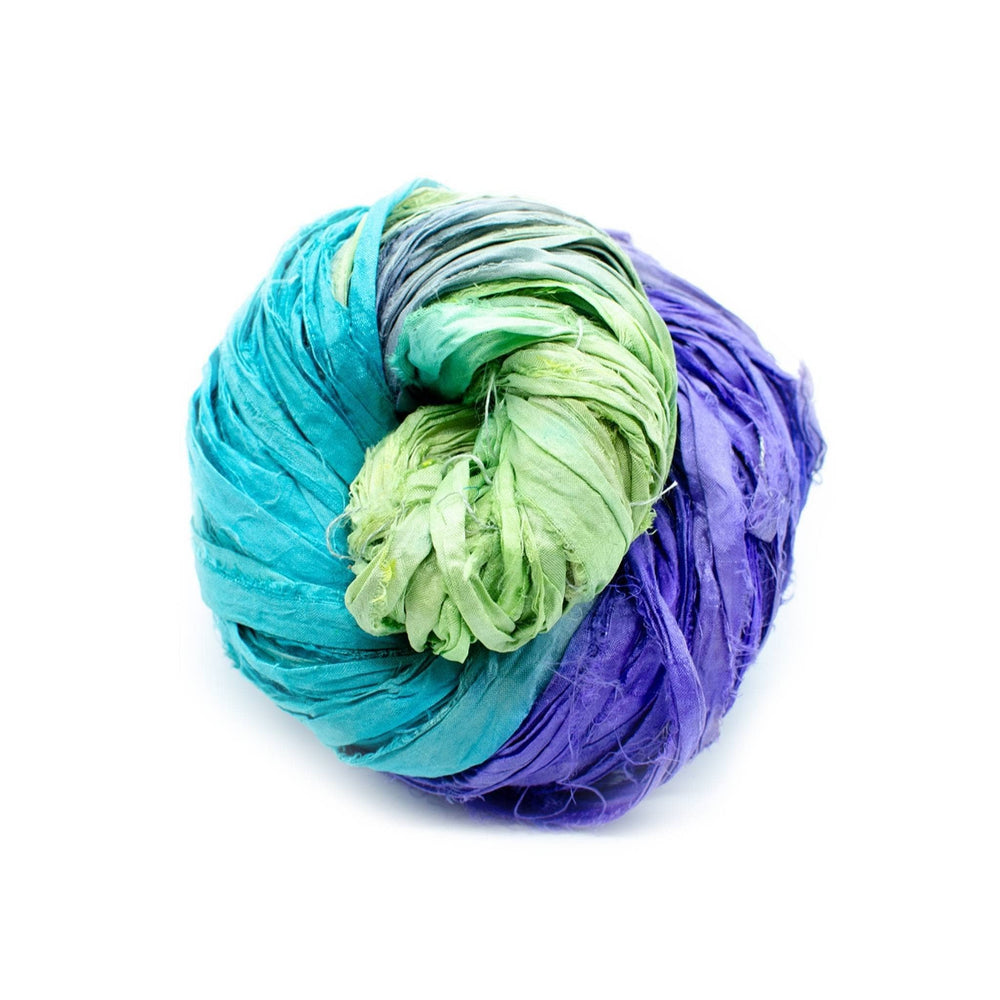
Basketweave wants a yarn with body, so the blocks stand up instead of flattening. A worsted weight yarn is the standard choice, and a bulky weight speeds up a blanket. Darn Good Yarn's recycled silk, hand-dyed by artisans in India, comes in both weights and adds a soft shine to the knit blocks that you don't get from matte wool.
If you'd like a new skein to practice on every month, Yarn of the Month sends three hand-dyed skeins with a knit and crochet pattern written for them, $29 a month plus shipping.
Basketweave Stitch FAQ
Is the basketweave stitch reversible?
Yes. Both sides show the same woven blocks, with the knit and purl surfaces swapped. It's one of the better choices for scarves and blankets for that reason.
Does the basketweave stitch curl?
No. The balance of knit and purl blocks keeps the fabric flat, so it needs no border.
What's the difference between basketweave and checkerboard?
Checkerboard uses square blocks of equal height and width that switch at the same count. Basketweave uses rectangular bands that offset each other, which gives the over-under woven look rather than a grid.