Rewards



The long tail cast on is the cast on most knitters use for almost everything. It puts a neat, slightly stretchy edge on the needle and, because each stitch is already wrapped and seated, your first row is a plain knit row instead of a fiddly one.
It takes a few tries to get the rhythm. The one thing that makes it work: your thumb holds the tail, your index finger holds the working yarn, and the needle makes the same small loop around both every time.
Watch: Long Tail Cast On Video Tutorial
Watch how the left hand sets up the "slingshot" hold, and how the needle goes up through the thumb loop before it catches the finger strand.
What You Need
A smooth, light-colored worsted or DK weight yarn shows the thumb loop best while you're learning. Use the needle size your pattern calls for; a US 7 or 8 (4.5 to 5 mm) with worsted yarn is comfortable to practice on.
Abbreviations: CO = cast on, st(s) = stitch(es), K = knit. Each loop you make counts as one stitch, including the slip knot.
Long Tail Cast On Written Steps
Note from the original tutorial: This tutorial is for our new knitters out there! This video walks you through how to cast on using the long tail method for knitting:) Happy Crafting!
Step 1: Pull out a tail of yarn (see the tail rule below), make a slip knot, and put it on one needle. Hold that needle in your right hand.
Step 2: With your left hand, put your thumb and index finger between the two strands so the tail goes over your thumb and the working yarn (the strand attached to the ball) goes over your index finger. Hold both strands against your palm with your other fingers.
Step 3: Bring the needle up through the loop on your thumb from below.
Step 4: Swing the needle over and catch the strand on your index finger, then bring it back down through the thumb loop.
Step 5: Drop the thumb loop and pull the tail to snug the new stitch up to the needle. Reset your thumb under the tail.
Step 6: Repeat Steps 3 to 5 until you have the number of stitches your pattern calls for.
Step-by-Step: How the Technique Works
- The slingshot hold. Hold the needle with the slip knot in your right hand. Spread the left thumb and index finger apart with the tail around the thumb and the working yarn around the index finger, both strands pinned in your palm.
- Up through the thumb loop. Tilt the needle down and slide the tip up under the strand on the outside of your thumb. You are going into the loop that the tail makes around your thumb.
- Catch the finger strand. Move the needle tip over the index-finger strand and hook it, coming back toward you. That strand becomes the new stitch.
- Back down and out. Bring the needle back down through the thumb loop, the same way it went in. Now let the thumb loop slide off.
- Snug and reset. Pull the tail so the stitch sits close to the needle but can still slide. Put your thumb back under the tail and you're set up for the next stitch. Each repeat ties a small knot at the base of a stitch, which is why the finished edge looks like a braid.
Tips and Common Mistakes
- The tail rule. Allow about one inch of tail per stitch in worsted weight yarn, plus ten inches of grace. For 40 stitches, pull out around 50 inches. Running out with five stitches to go is the classic mistake.
- Don't yank the tail. A cast on pulled too tight makes the first row hard to knit and the edge won't stretch. If you knit tightly, cast on over two needles held together, then slip one out.
- The slip knot counts as your first stitch, so include it when you count.
- Wrong way through the thumb. If your stitches are twisted or won't snug, you've gone over the thumb strand instead of up under it. Go back to Step 3 and watch the needle tip.
When You'll Use This
Nearly every flat project starts here: a scarf, a dishcloth, a blanket, a hat brim worked flat and seamed. It has enough give for ribbing, too. Chunky yarns work fine; just allow a longer tail per stitch.
Related Stitches
- Long Tail Cast On Without Measuring — a trick for getting the tail length right every time
- Provisional Cast On — the temporary cast on for when you'll need the stitches later
- Knit Garter Stitch — the first stitch pattern to knit once you're cast on
- Browse every knit stitch tutorial
Yarn for This Stitch
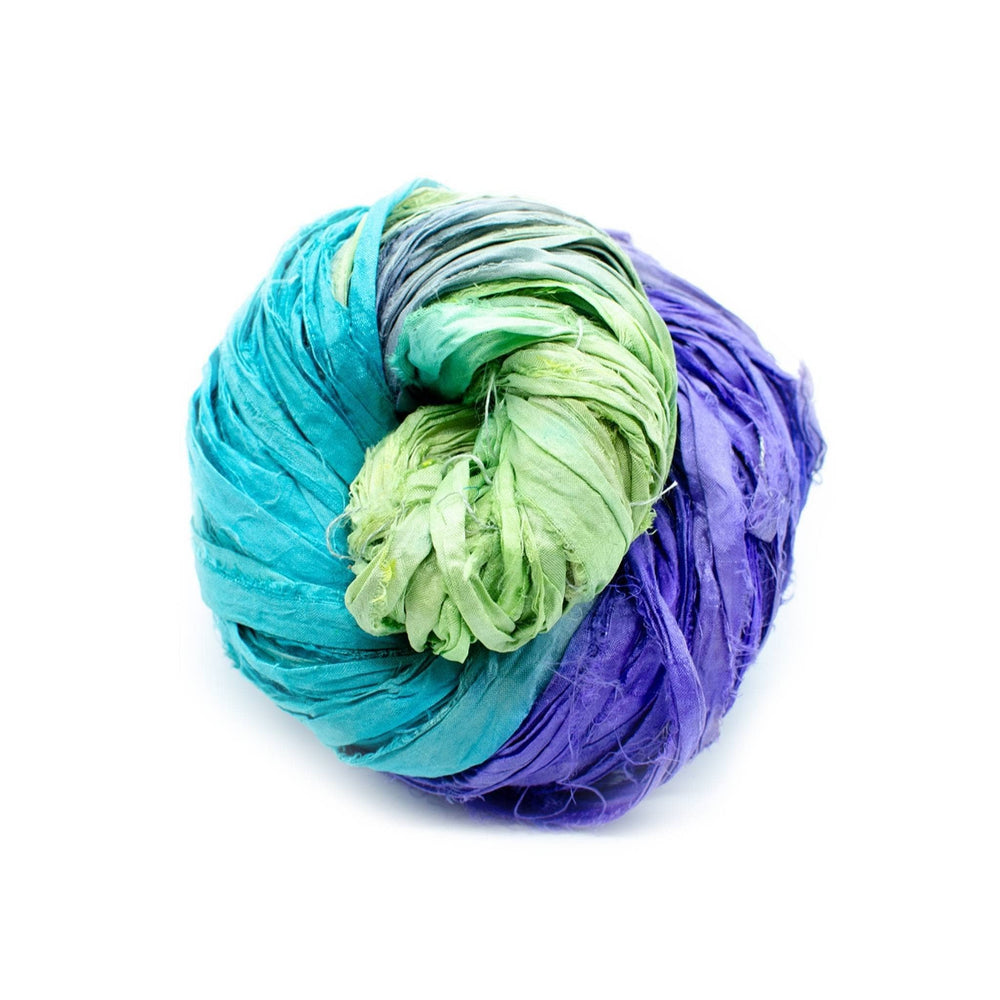
A smooth, mid-weight yarn is the easiest to learn on. Darn Good Twist Sport Weight Silk Yarn is smooth and even, so the thumb loop is easy to see, and DGY's worsted weight yarn is a little heavier in the hand. Both are recycled silk, hand-dyed by artisans in India.
If you'd like a new skein to practice on every month, Yarn of the Month sends three hand-dyed skeins with a knit and crochet pattern written for them, $29 a month plus shipping.
Long Tail Cast On FAQ
How long should the tail be for a long tail cast on?
About one inch per stitch in worsted weight yarn, plus an extra ten inches so you aren't cutting it close. Thicker yarn needs more; thinner yarn needs a little less.
Is the long tail cast on stretchy?
Moderately. It's enough for most hat brims and ribbed cuffs; for more stretch, cast on over two needles.
Do I knit or purl the first row after a long tail cast on?
Follow your pattern. The cast on row usually isn't counted as Row 1, and most patterns start with a knit row.