Rewards



The long tail cast on is the standard way to start most knitting: stretchy, tidy, and quick. Its one weakness is the tail. You have to guess how much yarn to pull out before you start, and a short guess means ripping out at stitch 180.
The no-measuring version fixes that by using two strands instead of one tail. One strand plays the part of the tail, the other is the working yarn, and because both come from a ball, neither can run out. When the cast on is done you drop one strand and knit on with the other.
It's a beginner technique. If you can do a regular long tail cast on, this is the same thumb-and-finger motion with a different setup.
Watch: Long Tail Cast On Without Measuring Video Tutorial
Watch how the two strands are set up before the first stitch and which strand goes over the thumb; that's the whole difference from the usual method.
The worst part about long tail cast on is having to measure an amount of yarn before you start. It could be too short or way too long and you end up wasting some good yarn! This method allows you to not have to measure, guaranteeing the correct amount of yarn every time. Enjoy and happy
What You Need
Any yarn and the needle size your pattern calls for. To learn it, use a smooth, light-colored worsted weight yarn on 5.0mm (US 8) needles so you can see which strand is which. You'll need two yarn ends: either the outside end and the center-pull end of the same ball, or the ends of two balls.
Abbreviations: CO = cast on; st = stitch; K = knit. There's no stitch multiple; this works for any stitch count. For other terms, see 70 knitting abbreviations every knitter should know.
Long Tail Cast On Without Measuring Written Steps
Step 1: Find both ends of your ball (or use two balls). Hold the two strands together and make a slip knot with both, leaving a short tail of a few inches. Place it on the needle. This knot is not counted as a stitch and comes out later.
Step 2: Hold the needle in your right hand. Separate the two strands: one goes over your left thumb, the other over your left index finger, exactly as in a normal long tail cast on. The thumb strand is your "tail."
Step 3: Cast on as usual: bring the needle up under the thumb loop, over and behind the finger strand, and back down through the thumb loop. Drop the thumb loop and snug the stitch.
Step 4: Repeat until you have the number of stitches the pattern asks for. Count the stitches but not the slip knot.
Step 5: Cut the thumb strand, leaving a tail of about six inches to weave in. Keep the finger strand as your working yarn.
Step 6: On the first row, work to the slip knot, then slide it off the needle and undo it. Weave in the short tails when the piece is finished.
Step-by-Step: How the Stitch Works
- In a regular long tail cast on, the thumb strand forms the bottom edge of each stitch and the finger strand forms the loop on the needle. The tail gets used up, which is why the guess matters.
- Here the thumb strand is a second live end from a ball, so it feeds as long as you need it. Nothing changes in the motion of the needle.
- When you stop, you have two strands attached to the needle. Cutting the thumb strand leaves a normal-looking long tail edge with one extra end to weave in.
Tips and Common Mistakes
- Make sure the two strands are coming from the ball freely. A snagged center-pull end will tighten your thumb loops and make the edge stiff.
- Don't count the slip knot. Casting on 60 plus the knot and then knitting it gives you 61 stitches and a bump at the edge.
- Keep the thumb strand the same tension as you would a tail. A loose thumb strand makes a loopy edge; a tight one makes an edge that won't stretch.
When You'll Use This
Any time the cast on is long enough that a wrong guess hurts: a blanket worked flat, a shawl started along its long edge, a sweater body, or a scarf cast on lengthwise. For a short cuff or a swatch, a regular long tail cast on with a generous tail is fine. If a blanket is your next project, how to knit a blanket covers how many stitches you'll be casting on.
Related Stitches
- Long Tail Cast On — the standard version, if you're new to it.
- Provisional Cast On — for edges you'll pick up and knit later.
- Knit Garter Stitch — the first thing to knit once the stitches are on the needle.
- Browse every knit stitch tutorial
Yarn for This Stitch
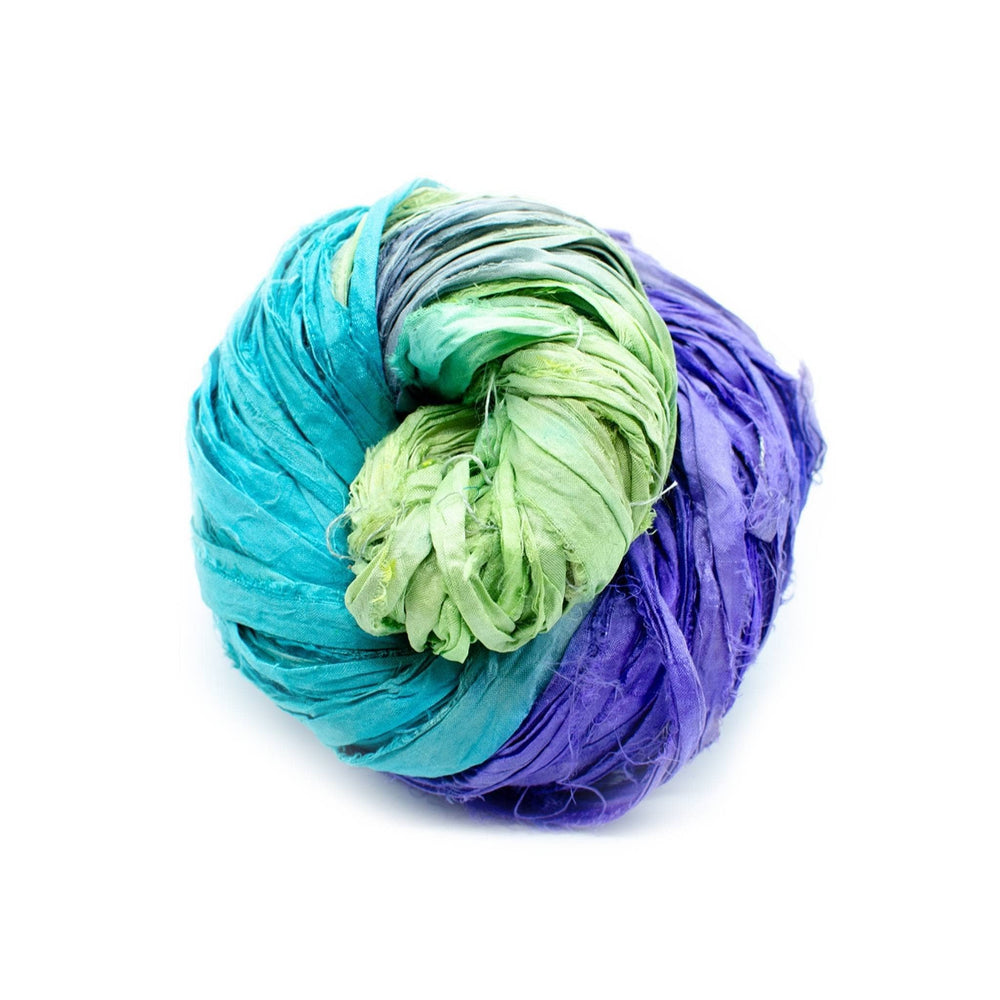
Learn it on a smooth worsted weight yarn where the two strands are easy to tell apart. Once it's automatic it works on anything from lace and fingering weight up to super bulky. For a sport weight project, Darn Good Twist Sport Weight Silk Yarn, hand-dyed by artisans in India, casts on cleanly with this method.
If you'd like a new skein to practice on every month, Yarn of the Month sends three hand-dyed skeins with a knit and crochet pattern written for them, $29 a month plus shipping.
Long Tail Cast On Without Measuring FAQ
Does this cast on look different from a regular long tail cast on?
No. The edge is identical. The only difference is one extra tail to weave in at the starting corner.
Can I use two different colors?
Yes, and it's a good way to learn: use one color on the thumb and another on the finger so you can see what each strand does. The thumb color will show along the bottom edge.
What if my ball doesn't have a center-pull end?
Use a second ball, or wind off a small ball by hand and use that as the second strand.