Rewards



The raspberry stitch covers the fabric in small, round bumps packed close together, like the surface of the berry. It's the same stitch many patterns call trinity stitch or blackberry stitch, and it's the texture inside a lot of classic Aran sweater panels.
The fabric is thick, squishy, and warm, and it doesn't curl. It's a four-row repeat where the bumps are made on the wrong-side rows and the right-side rows are plain purl, so half the knitting is easy.
It's listed as beginner because it uses only knit, purl, and purl-three-together. The one thing that makes it work is pairing every increase with a decrease: three stitches made from one, then three stitches purled into one, so the count never changes.
Watch: Knit Raspberry Stitch Video Tutorial
Watch how Mike works knit, purl, knit into a single stitch without dropping it off the needle until all three are made, and how the p3tog right after it pulls the count back.
What You Need
The swatch works in any yarn weight; worsted on a US 7 or 8 (4.5 to 5mm) needle is a good place to learn because the bumps are big enough to see and count. A smooth, light-colored yarn shows the texture best. Very fuzzy yarn hides the bumps, which defeats the point.
Abbreviations: k = knit, p = purl, p3tog = purl three stitches together, (k1, p1, k1) into the next stitch = work a knit, a purl, and a knit all into one stitch before sliding it off, making three stitches from one.
Stitch multiple: a multiple of 4 plus 2. The swatch casts on 34 stitches.
Knit Raspberry Stitch Written Pattern
Raspberry Stitch (multiple of 4 + 2)
Cast on 34 stitches.
Row 1: purl all stitches
Row 2: k1 * into the next stitch k1, p1, k1, then purl the next three stitches together, repeat from * to the last stitch, k1
Row 3: purl all stitches
Row 4: k1, * p3tog, into the next stitch k1, p1, k1, repeat from * to the last stitch, k1
Step-by-Step: How the Stitch Works
- Row 1: purl across. This is the right side of the fabric. Purling here sets up a reverse-stockinette background that the bumps sit on.
- Row 2: make a bump, then take one away. Knit 1 for the edge. Into the next stitch, knit, then bring the yarn forward and purl into the same stitch, then take it back and knit into it once more; now drop the original stitch. You've made three from one. Purl the next three stitches together. Repeat to the last stitch and knit 1.
- Row 3: purl across again. Another plain right-side row.
- Row 4: swap the order. Knit 1, then p3tog first, then (k1, p1, k1) into the next stitch. Repeat and end with k1. The bumps now land over the decreases of Row 2.
- Repeat Rows 1 to 4. Offsetting the bumps every other wrong-side row is what packs them in like berries instead of lining them up in columns.
Tips and Common Mistakes
- Count at the end of Rows 2 and 4. If you have more than 34 stitches, you made a bump without the p3tog beside it; fewer, and you did the reverse.
- The p3tog is the tight spot. Keep the three stitches loose on the row before, or use the needle tip to spread them before you purl through.
- The right side is the purl-row side, which feels backwards. The bumps you make on Rows 2 and 4 pop out on the other face. Mark the right side early.
- Don't pull the (k1, p1, k1) too tight or the bump flattens. Let it be a little loose; the p3tog on the next bump row tidies it.
- This stitch eats yarn. Expect to use noticeably more than stockinette for the same size.
What to Make With the Knit Raspberry Stitch
Anything you want thick and cozy. In worsted or aran, a scarf is the classic first project, and the stitch lies flat so no border is needed; see our how to knit a scarf guide for length and width. In bulky yarn it makes a fast, dense cowl or a cushion cover. In DK, a panel of raspberry stitch between cables is the traditional Aran use, and a hat band in it looks like a row of tiny berries.
Related Stitches
- Knit Bobble Stitch — bigger, spaced-out bumps using a similar idea
- Knit Seed Stitch — a flatter all-over texture that pairs well beside raspberry panels
- Knit Cable Stitch — the stitch raspberry usually sits next to in Aran work
- Browse every knit stitch tutorial
Yarn for This Stitch
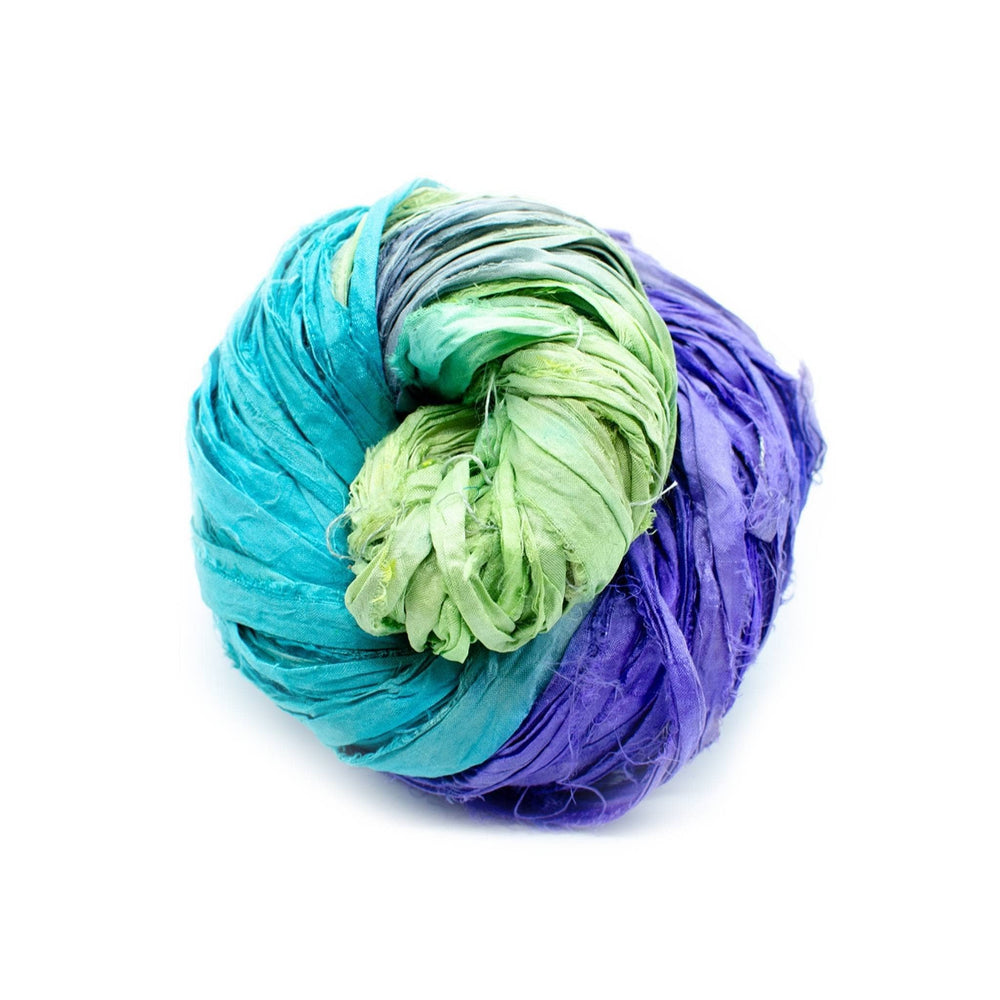
Raspberry stitch wants a round, smooth yarn with some body so the bumps stay plump. Our worsted weight yarn is the natural fit for scarves and cushions. For a lighter cowl or hat band, Darn Good Twist Sport Weight Silk Yarn is a recycled silk, hand-dyed by artisans in India, and the sheen makes each bump catch the light.
If you'd like a new skein to practice on every month, Yarn of the Month sends three hand-dyed skeins with a knit and crochet pattern written for them, $29 a month plus shipping.
Knit Raspberry Stitch FAQ
Is raspberry stitch the same as trinity stitch?
Yes. Raspberry, trinity, and blackberry stitch are the same four-row pattern: three stitches made from one, then three purled together, offset every other bump row.
Does the raspberry stitch curl?
No. The bumps and the purl background balance each other, so the fabric lies flat without edging.
Is the raspberry stitch reversible?
No. The bumps show on one side; the other is a flatter purl texture. Both are tidy, so a scarf still looks fine from the back.