Rewards



The knit daisy stitch covers the fabric with small, raised clusters that look like a field of tiny flowers. Each cluster is three stitches gathered at the base and fanned out at the top, and they're offset row to row so the flowers sit in a staggered grid.
It's an intermediate stitch, but not because the moves are hard. The trick is that you purl three stitches together twice without dropping them off the needle, with a yarn over in between. That takes a loose hand and a little patience.
The one thing that makes it work is casting on with a larger needle than you'd normally use. The cluster row pulls the fabric tight, and a looser cast on keeps the bottom edge from flaring.
Watch: Knit Daisy Stitch Video Tutorial
Watch the cluster closely: the three stitches stay on the left needle through the first purl 3 together and the yarn over, and only come off after the second purl 3 together.
What You Need
Yarn: A DK or sport weight with some give. The repeated purl 3 together is easiest in a yarn that stretches a little, and a smooth, light-colored yarn shows the flower shapes best while you learn.
Needles: Cast on with a needle one or two sizes larger than the label recommends, then switch to the recommended size for the rows. For DK, that's usually a US 8 for the cast on and a US 6 for the knitting.
Abbreviations (US terms): K = knit, P = purl, YO = yarn over, P3tog = purl 3 stitches together.
Stitch multiple: Multiple of 4 + 1. The swatch uses 29.
Knit Daisy Stitch Written Pattern
Daisy Stitch - multiple of 4 +1
Cast on 29 stitches using a needle size larger than the one recommended
Row 1: knit all stitches
Row 2: knit 1, * into the same stitches, purl 3 together, YO, purl 3 together, then knit 1* repeat from * to * to end of row
Row 3: knit all stitches
Row 4: knit 1, purl 1, knit 1 *into the same stitches, purl 3 together, YO, purl 3 together, then knit 1* repeat from * to * to the end of the row, ending purl 1, knit 1
Repeat 4 rows for pattern.
Step-by-Step: How the Stitch Works
- Row 1 is a rest row. Knit every stitch. This gives the clusters a firm base and lets you check your count: 29.
- Start the cluster. On row 2, knit 1. Put the right needle through the next three stitches purlwise and purl them together, but do not slide them off the left needle.
- Yarn over and purl again. Bring the yarn over the right needle, then purl the same three stitches together a second time. Now slide all three off. Three stitches have become three stitches: a purl, a yarn over, and a purl.
- Finish the repeat. Knit 1 to separate the clusters, then cluster, knit 1, cluster, knit 1 to the end of the row.
- Offset on row 4. Knit 1, purl 1, knit 1 before the first cluster and end with purl 1, knit 1. This shifts every cluster two stitches over, so the row 4 flowers sit between the row 2 flowers.
- Stack the repeats. Four rows make one repeat, and each adds a staggered line of daisies.
Tips and Common Mistakes
- If the purl 3 together won't go, you're too tight. Loosen up on the knit rows or go up a needle size for the whole swatch.
- Don't drop the stitches early. The most common error is letting the three stitches slide off after the first purl 3 together. If your count drops to 27, that's what happened.
- Count after every cluster row. You should still have 29. The knit 1 between clusters is easy to skip when you're concentrating on the hard part.
- The right side is the cluster side. Rows 2 and 4 are both worked on the same face, so the flowers all show on one side. Mark it with a stitch marker.
What to Make With the Knit Daisy Stitch
Daisy stitch is dense and textured, so it suits pieces where you want warmth and a pretty surface:
- Baby blanket in a soft DK with a seed stitch border. See how to knit a blanket for sizing.
- Cowl in worsted weight. The texture looks good from both close up and far away.
- Cardigan panels or a yoke accent in sport weight.
Related Stitches
- Knit Bobble Stitch — another raised cluster, bigger and more spaced out
- Knit Raspberry Stitch — a beginner-friendly cluster texture to try first
- Knit Trellis Lace Stitch — practice with yarn overs before adding the purl 3 together
- Browse every knit stitch tutorial
Yarn for This Stitch
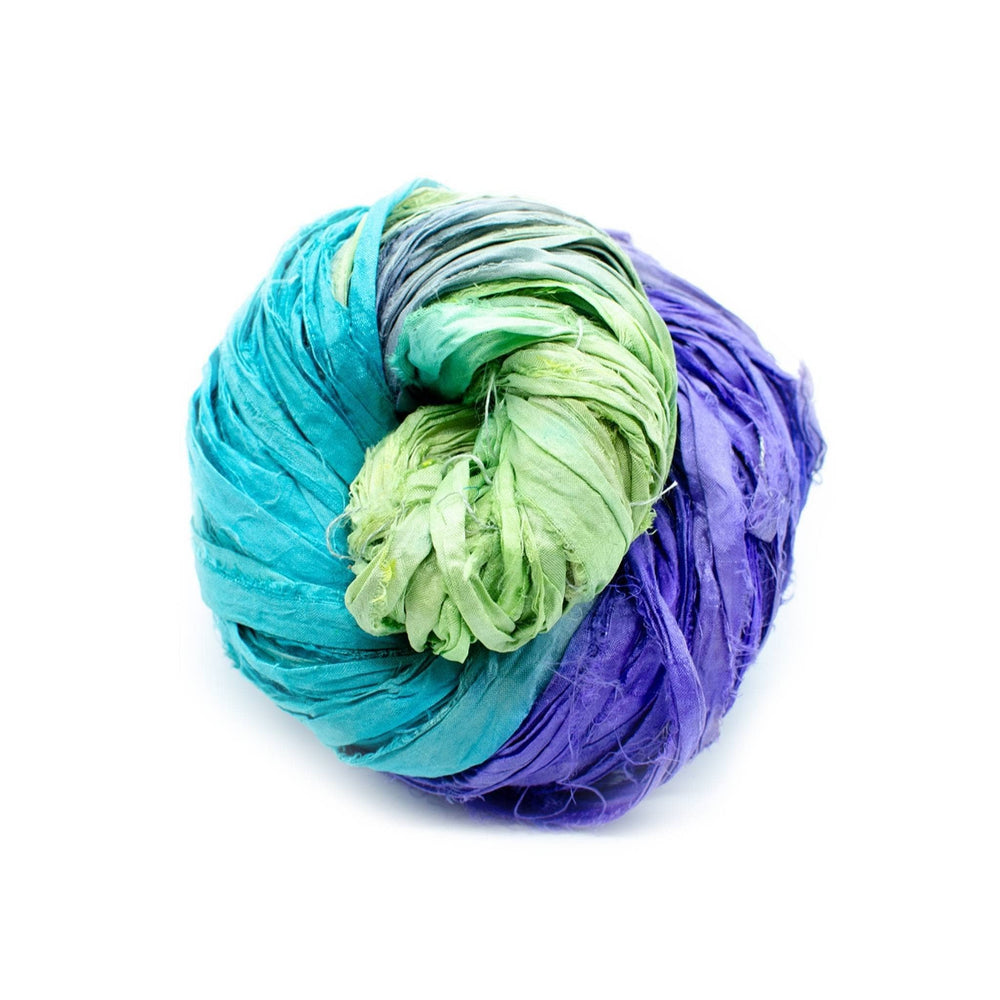
A sport weight recycled silk with a little stretch makes the purl 3 together easier and gives the daisies a soft sheen. Darn Good Twist Sport Weight Silk Yarn is hand-dyed by artisans in India and sits well on a US 6 needle. For a warmer blanket, look at the DK weight yarn collection.
If you'd like a new skein to practice on every month, Yarn of the Month sends three hand-dyed skeins with a knit and crochet pattern written for them, $29 a month plus shipping.
Knit Daisy Stitch FAQ
Is the knit daisy stitch reversible?
No. All the clusters are worked on the same face of the fabric, so the right side shows the flowers and the wrong side shows a smooth, slightly ridged texture.
Does daisy stitch curl?
Very little. The clusters pull the fabric in and the knit rest rows balance them, so it lies much flatter than stockinette. A quick block removes any wave at the edges.
Is daisy stitch hard for beginners?
It's a step up from basic knit and purl. The double purl 3 together feels awkward at first, but once your tension loosens it's a four-row repeat you can memorize.