Rewards



Somewhere in your house is the scrap bag. Tails from finished blankets, half-skeins from hats, the three yards of that one silk you couldn't bring yourself to toss. It grows every year and it never seems to shrink.
This post is the plan for shrinking it. First, how to sort it so the projects are easy to pick. Then sixteen things to make, from "a few yards" to "half a skein."
Sort first: by weight, then by amount
Scrap projects go wrong when you mix a fingering tail with a bulky one and the fabric buckles. Spend twenty minutes sorting:
- By weight. Lace and fingering in one bag, DK and sport in another, worsted in a third, bulky in a fourth. If you can't tell, this chart and a ruler will sort it.
- By amount. Inside each bag, wind the longer pieces into balls and leave the short tails loose. Anything under about 5 yards is for the "yards" projects below. Anything over 30 is for the "half-skein" ones.
- By fiber, loosely. Silk and cotton together, wool and acrylic together. It matters for washing more than for crocheting.
A few yards (under 5 yards each)
1. Tassels and fringe. The scraps nobody can use are exactly the right length for tassels. Add them to a plain scarf and it's a different scarf.
2. Pom-poms. Mixed colors make the best ones. Hat toppers, garlands, gift toppers.
3. Scrap-yarn appliqué. A flower, a heart, a cat. Our cat appliqué pattern was written for exactly this.
4. Stitch markers and gift ties. A few inches of pretty yarn, knotted into a loop, marks a stitch or ties a package.
5. A crochet gift bow. Reusable, and it uses up tails. Pattern here.
Small balls (5 to 30 yards each)
6. Granny squares. The reason the granny square exists. Each round can be a different scrap; sort by weight and the squares will join flat.
7. Striped coasters. One scrap per round. Six coasters, six color stories.
8. Mug cozies and jar covers. 20 yards of worsted goes around a mug. Great for the awkward middle-sized scraps.
9. A striped headband. Change color every two rows. Uses ten scraps and looks intentional.
10. Amigurumi parts. Eyes, noses, scarves for a small bear. The small-scrap projects of choice for anyone who makes toys.
Half-skeins (30 yards and up)
11. A scrappy striped scarf. Pick one weight, change color whenever a ball runs out, and don't plan it. The randomness is the look.
12. A temperature blanket, scrap edition. Instead of buying a palette, assign each scrap color a temperature range. A year later you have a blanket and an empty bag.
13. A market bag in stripes. Mesh stitches use little yarn, so half-skeins go a long way.
14. A scrap-yarn rug. Hold two or three strands of lighter scraps together to make a bulky-equivalent, then crochet a round rug in single crochet. Uses an enormous amount of scrap and is sturdy underfoot.
15. A patchwork cushion cover. Squares or rectangles in one weight, joined and backed. Each one uses a different half-skein.
16. A scrappy shawl. In fingering scraps, a simple triangle shawl that changes color every few rows. The one scrap project people get stopped on the street about.
Making mixed scraps look intentional
- Pick one unifying color. A black, cream or deep blue round between every scrap stripe turns chaos into a palette.
- Keep weights matched. Or hold thinner scraps double to match thicker ones.
- Repeat a color three times. Even in a random stripe sequence, bringing one color back three times reads as design.
- Mind the fiber for washing. Silk and wool scraps want a gentle hand wash; acrylic and cotton can take the machine. A rug made of all three gets hand-washed.
Where good scraps come from
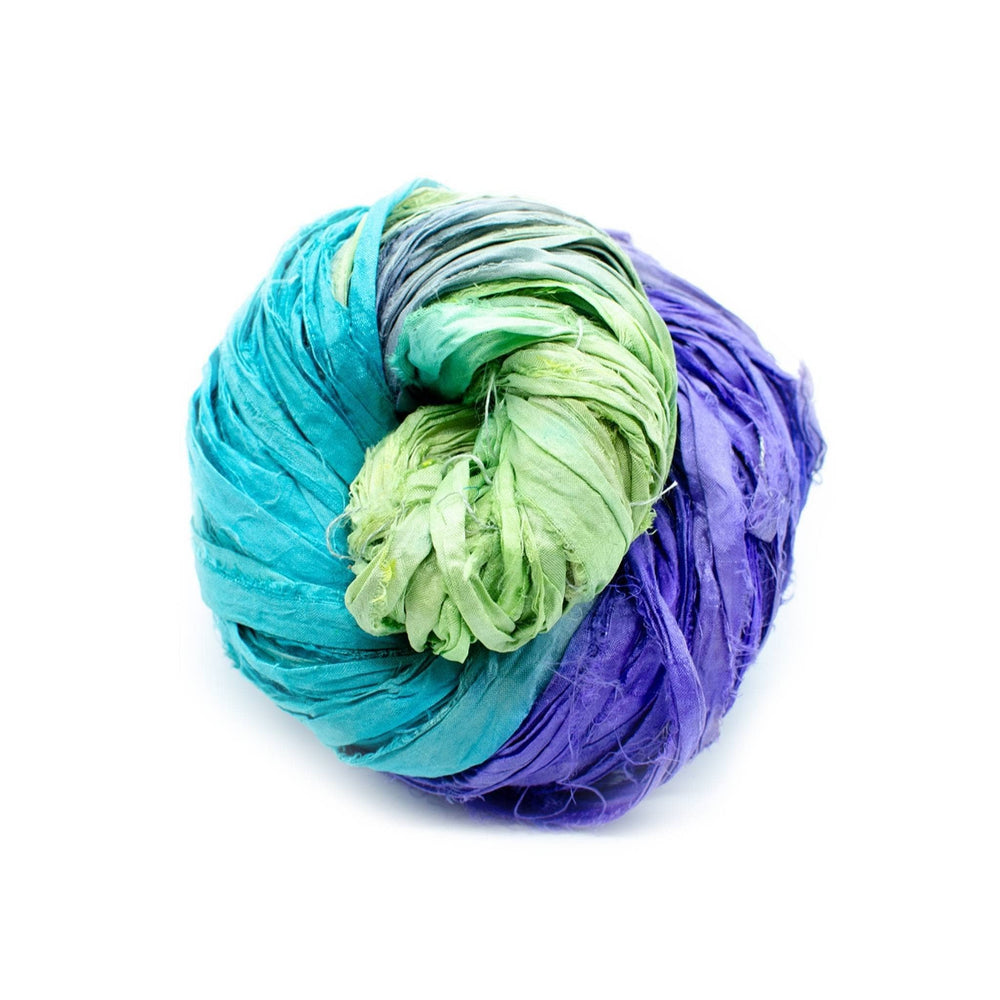
The best scrap bags are full of yarn you were happy to have in the first place. One reason Yarn of the Month members end up with such good scrap bags: three hand-dyed skeins of recycled silk a month in rotating colors and weights means the leftovers are the kind you'd pay for. And a one-time Editor's Box, nine or more mixed skeins, is the fastest way to build a scrap-friendly stash from scratch.
Scrap yarn crochet FAQ
What can I crochet with leftover yarn?
Granny squares, coasters, striped scarves and headbands, appliqués, tassels and pom-poms, and for large amounts of scrap, a rug or a patchwork cushion. Sort scraps by weight first.
How do I crochet with different yarn weights together?
Hold thinner strands doubled to match thicker ones, or keep each project to a single weight. Mixing weights in one row makes the fabric wavy.
How do I join scrap yarn without knots?
Use a Russian join or a magic knot for most yarns, or simply crochet over the tails for a few stitches. Felted joins work for wool only.