Rewards



Worsted weight yarn is the middle of the road: not thin, not chunky, the weight most knitting and crochet patterns in North America are written for. If a pattern just says "yarn" with no weight, it probably means worsted.
That's the short answer. Here's the rest.
What "worsted" actually means
Two different things, confusingly.
As a weight, worsted is category 4 on the Craft Yarn Council's 0-to-7 scale — a medium-weight yarn that knits at roughly 16 to 20 stitches over 4 inches on US 7 to 9 needles (4.5 to 5.5 mm), or crochets at about 11 to 14 single crochet over 4 inches on an I-9 to K-10.5 hook (5.5 to 6.5 mm). On a label, look for the number 4 inside a little skein symbol, or the word "medium."
As a spinning method, "worsted-spun" describes yarn made from fibers combed parallel before spinning, which gives a smooth, dense strand. The word comes from Worstead, a village in Norfolk, England, where the method was developed. A worsted-spun yarn can be any weight; a worsted-weight yarn can be spun any way. When a pattern or a shop says "worsted," they almost always mean the weight.
Worsted vs. the weights on either side
The weights next to worsted are where most confusion lives.
- DK (category 3, "light") is a step thinner: about 21 to 24 stitches per 4 inches on US 5 to 7 needles. DK and worsted can sometimes substitute for each other if you swatch, but you'll use more DK yardage for the same project. (Our guide to DK vs. sport weight covers the thin end in more detail.)
- Aran is worsted's slightly heavier cousin. Both are category 4; aran is at the thick end of it, around 16 to 18 stitches per 4 inches. Many UK patterns say "aran" where a US pattern says "worsted."
- Bulky (category 5) is a real step up: 12 to 15 stitches per 4 inches on US 9 to 11 needles. Not a substitute for worsted.
How to tell if a mystery skein is worsted
Lost the label? Three checks, in order of reliability:
- Swatch it. Knit 4 inches on US 8 needles. If you get 16 to 20 stitches, it's worsted. This is the only method that's actually right every time.
- Wraps per inch. Wrap the yarn snugly around a ruler without overlapping. Worsted is usually 9 to 12 wraps per inch; DK is 12 to 15; bulky is 7 to 8.
- Compare to a labeled skein. Hold the mystery strand next to a known worsted. Your fingers are better at this than you'd think.
Hand-dyed and recycled yarns are often a little uneven along their length, which is normal — swatch over a decent stretch rather than measuring one spot.
What to make with worsted weight yarn
Almost everything. Worsted is the all-purpose weight because it's fast enough to finish a project in a weekend and fine enough to show stitch detail.
- Hats and cowls: one skein (about 200 yards) does it.
- Scarves and shawls: two to three skeins.
- Bags and baskets: worsted holds its shape well, especially in silk or cotton.
- Blankets and sweaters: the standard. Count on 1,000 to 1,500 yards for an adult sweater.
- Dishcloths and washcloths: worsted cotton or silk; our waffle stitch washcloth pattern is a good first project.
Worsted in recycled silk
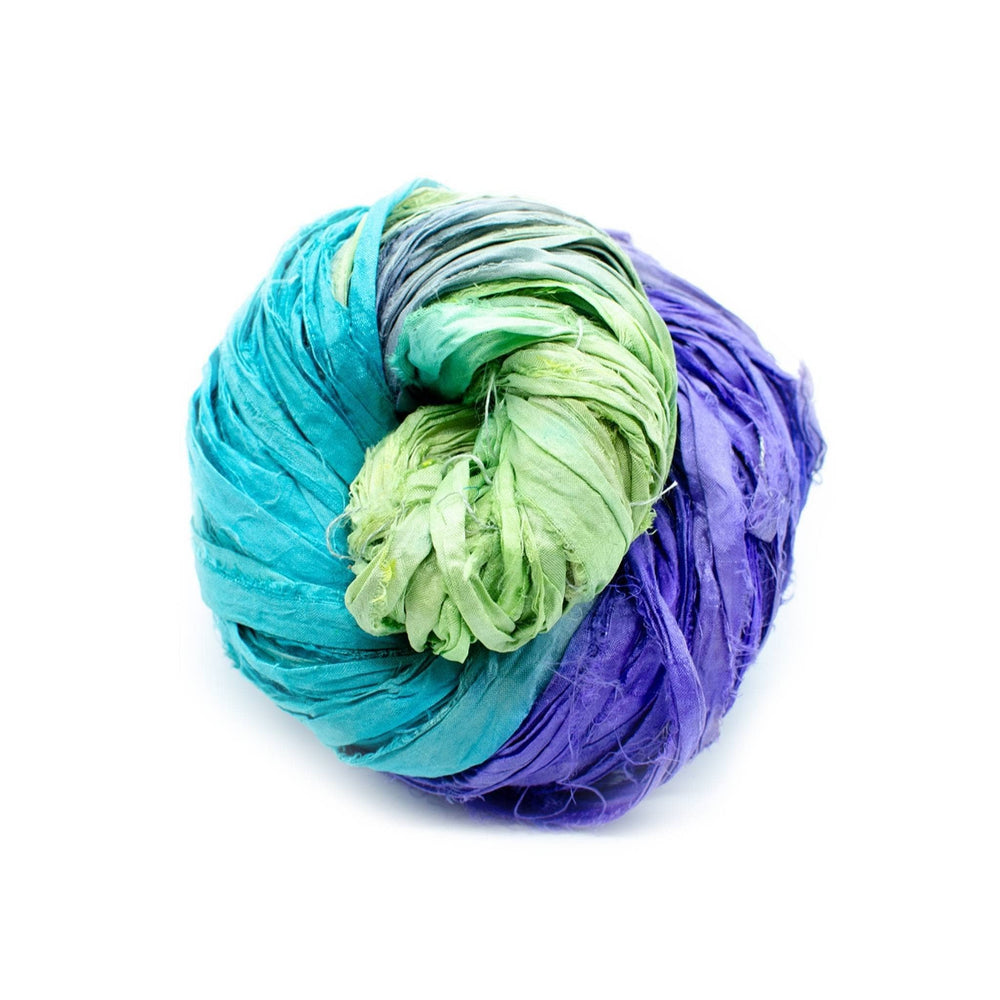
Most people meet worsted as wool or acrylic. In recycled silk it behaves a little differently: more drape, a sheen that catches light, and a slightly uneven texture from being hand-spun and hand-dyed by artisans in India and Nepal. It's beautiful in scarves, bags and anything where you want the fabric to move. For a first silk project, follow a pattern written for it rather than substituting straight into a wool pattern.
A good way to meet several weights without committing to a whole skein wall is a subscription. Yarn of the Month sends three hand-dyed skeins a month — worsted some months, DK or lace others — with a pattern written for that exact yarn, so the weight question is answered for you. $29 a month plus shipping, cancel anytime.
Worsted weight yarn FAQ
Is worsted weight the same as 4 ply?
No. In US terms, "4 ply" on a label sometimes means category 4 (worsted), but in UK and Australian terms "4 ply" is a thin fingering-weight yarn. Go by the gauge, not the ply name.
What size crochet hook for worsted weight yarn?
I-9 to K-10.5 (5.5 to 6.5 mm) is the standard range. Go smaller for a dense fabric (baskets, amigurumi), larger for drape (shawls).
Can I substitute DK for worsted?
Often, if you swatch and adjust. DK is thinner, so you may need to go up a needle size and you'll use roughly 10 to 20 percent more yardage. For a garment with fitted sizing, stick to the weight the pattern calls for.