Rewards


Here's a humbling little fact: the chicken pecking around a backyard sees a richer, wilder, more colorful world than you do. And it's not even close.
Our friend Capt Sam posted a reel about this the other day, and honestly we couldn't stop thinking about it. So we went down the rabbit hole (chicken coop?) to find out: can chickens really see more colors than humans? The answer turns out to be a resounding, feather-ruffling yes — and it says something kind of beautiful about why color matters so much to those of us who make things by hand.
Wait, chickens see more colors than us?
They do. Humans are what scientists call trichromatic — we have three types of color-detecting cone cells in our eyes, tuned to red, green, and blue. Mix those three and you get every color you've ever seen.
Chickens are tetrachromatic. They have a fourth cone, and it picks up ultraviolet light — a whole band of the spectrum that is completely, permanently invisible to human eyes. Where you see a plain patch of grass, a chicken may see it glowing with patterns and shades you have no word for, because you've literally never seen them.
A chicken doesn't see a fourth color. It sees an entire fourth dimension of color — one we can't even imagine.
A few more facts to make you side-eye your backyard flock
- ✦ They have built-in sunglasses. Tiny colored oil droplets sit in front of their cones, filtering light and sharpening the colors they see — like a permanent pair of tinted lenses.
- ✦ They see the world in fast-forward. A chicken processes far more visual frames per second than we do, so a fluorescent light that looks steady to us looks like a flickering strobe to them.
- ✦ Nearly all-around vision. With eyes on the sides of their heads, chickens have close to a 300-degree field of view. Sneaking up on one in daylight is basically impossible.
- ✦ The UV cone has a job. It helps them spot shiny bugs, ripe berries, and seeds that pop against the dull, non-glowing dirt. Useful when lunch is camouflaged.
Why this makes us think about color all day
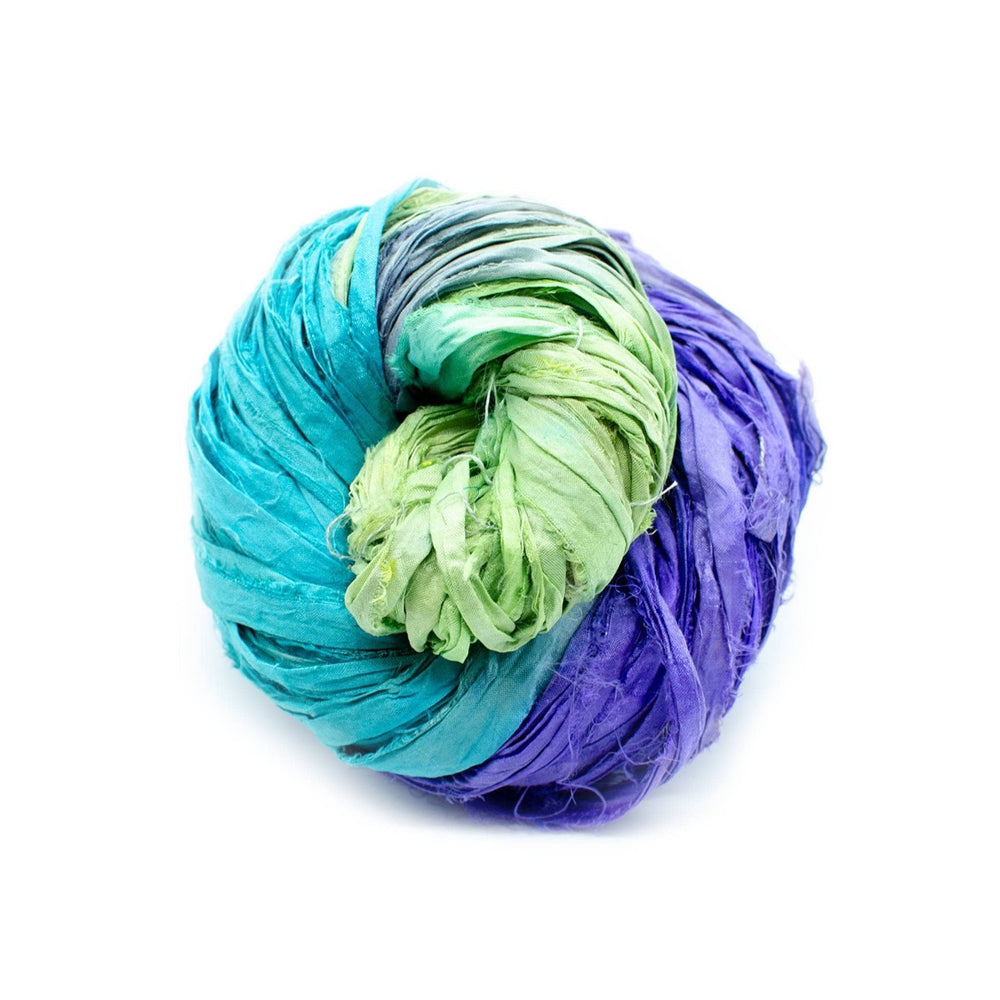
Here's where it gets personal for us. At Darn Good Yarn, color is the whole point. Our sari silk is made by hand by artisans in India and Nepal, and every piece carries colors you don't see in a regular store — deep jewel tones, unexpected pairings, the kind of vibrant, joyful color that stops you in your tracks.
We can't see ultraviolet like a chicken can. But the next best thing? Wrapping yourself in colors so rich and layered they make the everyday world feel a little more alive. That's the magic of something made by human hands — every skirt is one of a kind, with its own character, its own combination of colors that will never be repeated exactly.
Want to experience chicken-level color?
You'll have to settle for human-level — but our famous Original Sari Wrap Skirt is about as close as it gets. One skirt, endless color, made by hand and never the same twice.
Shop the Sari Wrap Skirt →So the next time you catch a hen tilting her head at you, give her a little credit. She's seeing a version of the world we'll never get to. The least we can do is fill ours with as much color as we possibly can.
Happy making,
Nicole
Sources: Lafeber Company, VAL-CO, Omlet, and BackYard Chickens on avian tetrachromatic vision. Chickens have four cone types (red, green, blue, and ultraviolet) versus the three found in human eyes.