Rewards



The cloverleaf eyelet cable is a narrow lace rib: three-stitch knit panels separated by two purl stitches, with a cluster of three eyelets in each panel every six rows. Two eyelets sit side by side, one sits above them, and together they make a small three-leaf clover. The panels stand up like cables, which is where the name comes from.
No cable needle is needed. The "cable" is just the raised stockinette panel on a purl background; the texture comes from yarn overs and decreases.
It's rated intermediate because of the double decrease on Row 2: slip one, knit two together, pass the slipped stitch over. Once that move is comfortable, it's a six-row repeat with three plain rows.
Watch: Cloverleaf Eyelet Cable Video Tutorial
Watch Row 2 closely: the yarn over, the slip-k2tog-psso decrease, and the second yarn over all happen in a three-stitch space.
What You Need
Worsted weight yarn on 5.0mm (US 8) needles matches the swatch. A smooth, light-colored yarn shows the eyelets while you learn; a fuzzy yarn fills the holes in.
Abbreviations: CO = cast on; K = knit; P = purl; YO = yarn over; Sl = slip one stitch; K2tog = knit two together; Psso = pass the slipped stitch over; Ssk = slip, slip, knit the two slipped stitches together.
Stitch multiple: multiple of 5 + 2. The swatch casts on 22: a 2-stitch purl column, then four panels of 3 knit stitches and 2 purls. For every abbreviation, see 70 knitting abbreviations.
Cloverleaf Eyelet Cable Written Pattern
Size: 6"x6"
Gauge: 4x4 = 16sts by 20 rows in stockinette
Yarn: 26g of DGY worsted weight recycled silk
Knitting Needle Size: 5.0mm
Abbreviations: K: Knit; P: Purl; Sl: Slip a stitch; Psso: Pass slipped stitch over; Ssk: Slip, slip knit decrease; YO: Yarn Over
Note: * indicates to repeat across.
CO 22
Row 1: K2, *P3, K2.
Row 2: P2* YO, Sl, 1 – K2 tog – Psso, YO, P2.
Row 3: K2, *P3, K2.
Row 4: P2, *K1, YO, Ssk, P2.
Row 5: K2, *P3, K2.
Row 6: P2, *K3, P2.
Rows 7-24: Repeat Rows 1-6.
Step-by-Step: How the Stitch Works
- Cast on 22. Rows 1, 3, and 5 are the wrong-side rows and they're all the same: K2, then P3, K2 across. They keep the panels in stockinette and the columns in reverse stockinette.
- Row 2 makes the bottom two leaves. Purl 2, then in each 3-stitch panel: yarn over, slip 1, knit 2 together, pass the slipped stitch over, yarn over. The double decrease takes three stitches to one, and the two yarn overs bring the count back to three. Purl 2 and repeat.
- Row 4 makes the top leaf. Purl 2, then in each panel: knit 1, yarn over, ssk. One stitch out, one stitch in, so the count holds.
- Row 6 is a rest row on the right side: purl 2, knit 3 across. The three knit stitches close the clover.
- Repeat Rows 1 through 6. Each repeat places a new clover directly above the last, so the panels read as a column of leaves between purl ribs.
Tips and Common Mistakes
- Count each panel after Rows 2 and 4. It should still be 3 stitches. If it's 2, you dropped a yarn over; if it's 4, you missed the decrease.
- Don't pull the yarn overs tight on the next row. Purl them at normal tension on Row 3 and the eyelets open evenly.
- The right side is the face with the eyelets and the raised knit panels. Even rows are right-side rows, which is the reverse of many patterns, so mark it.
- Row 2 and Row 4 are easy to swap. Row 2 has the double decrease; Row 4 has the ssk. Keep the row counter moving.
- The rib structure pulls in, so block the finished piece to open the clovers. It uses slightly less yarn than plain stockinette at the same width.
What to Make With the Cloverleaf Eyelet Cable
Because it's a rib, it suits anything with a bit of stretch: a sport or fingering weight scarf, the body of a worsted weight hat, a DK cardigan panel, or the cuff of a sock. One panel repeated across a baby blanket in DK gives an all-over lace rib. A scarf in this stitch needs no border; the purl columns at each edge already frame it, and how to knit a scarf covers length and yarn planning.
Related Stitches
- Eyelet Mock Cable Ribbing — the closest cousin, another eyelet rib without a cable needle.
- Lace and Cable Stitch — the next step, with a real cable cross.
- Trellis Lace Stitch — more yarn-over practice in an all-over lace.
- Browse every knit stitch tutorial
Yarn for This Stitch
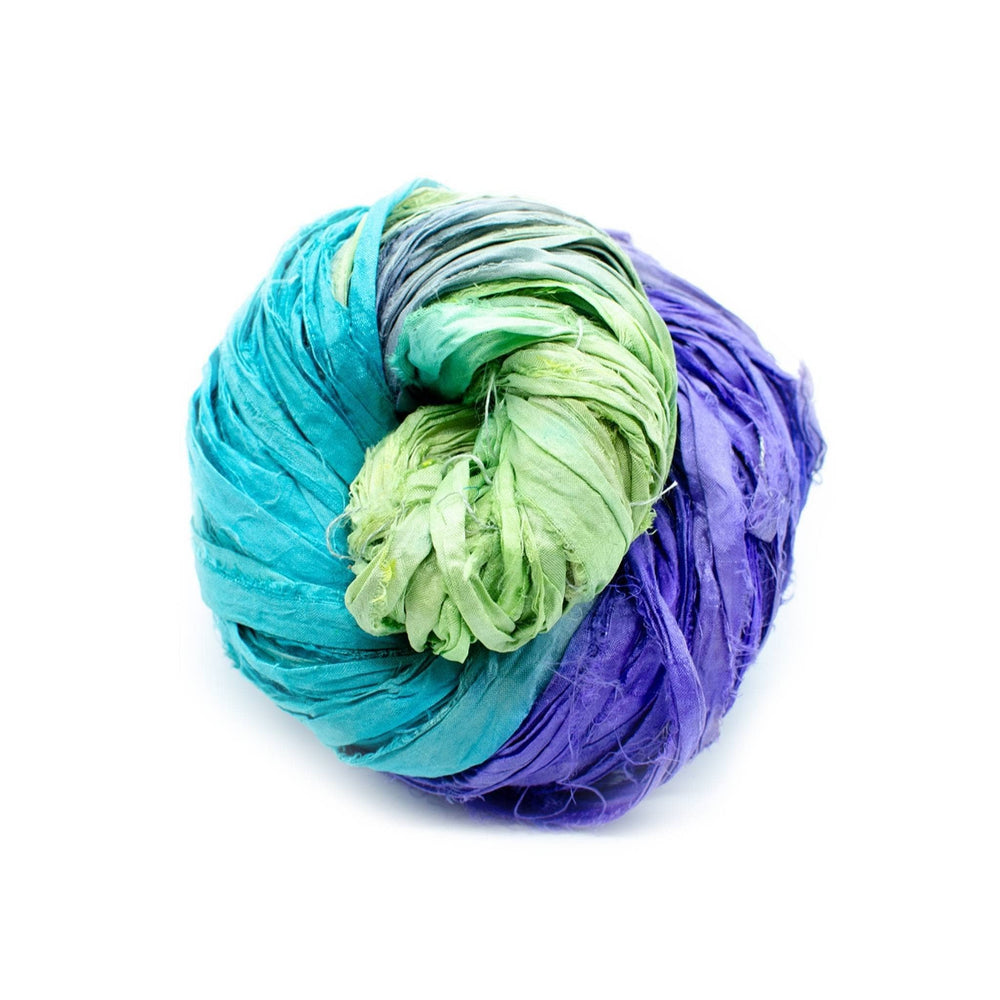
The swatch is worsted weight recycled silk on 5.0mm needles. For eyelets that read cleanly, a sport weight yarn on smaller needles is a good match, and Darn Good Twist Sport Weight Silk Yarn, hand-dyed by artisans in India, has the smooth twist that keeps each clover crisp. Worsted weight makes a bolder, warmer version.
If you'd like a new skein to practice on every month, Yarn of the Month sends three hand-dyed skeins with a knit and crochet pattern written for them, $29 a month plus shipping.
Cloverleaf Eyelet Cable FAQ
Do I need a cable needle for the cloverleaf eyelet cable?
No. The raised panels are plain stockinette on a purl background. There's no stitch crossing, only yarn overs and decreases.
Is it reversible?
No. The eyelets are visible on both sides, but the raised panels and the clover shape only read on the right side.
Does it curl?
No. It's a rib, so it pulls in sideways a little but lies flat without a border.